
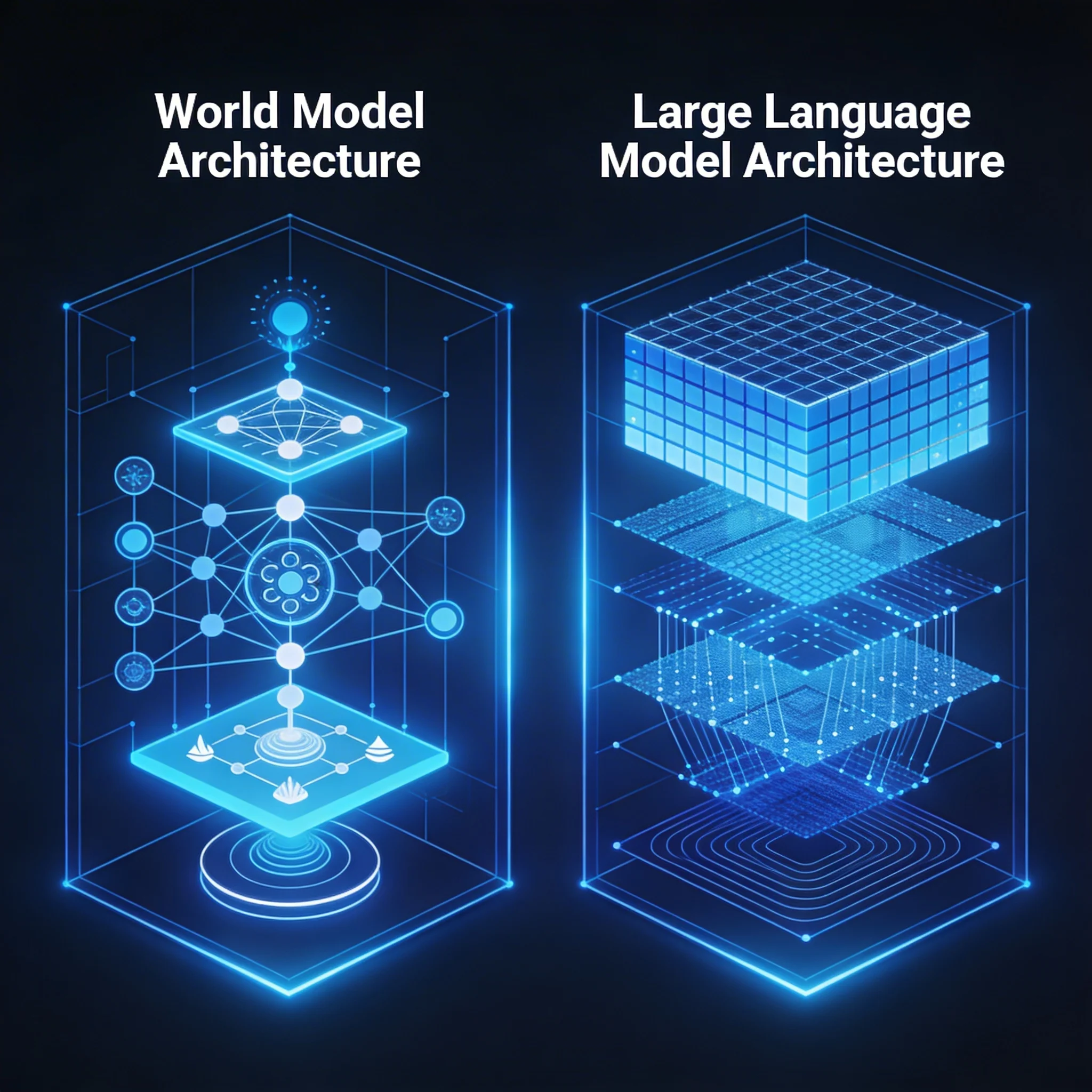
Every AI agent that takes actions in the world needs some model of how that world works. The question is whether that model should be explicit and structured — maintained as a separate component the agent can query and update — or implicit and distributed — embedded in the parameters of a large language model through pretraining on human-generated text.
This is not just a technical debate. The answer shapes how well agents generalize to novel environments, how reliably they recover from errors, how their behavior can be audited, and ultimately how much autonomy they can be trusted with.
The Case for World Models
A world model, in the technical sense, is a learned or hand-crafted representation of an environment that predicts the consequences of actions. Given the current state of the environment and a proposed action, the world model returns the expected next state, along with uncertainty estimates.
The classic research lineage here runs through Schmidhuber's early work on recurrent neural networks in the 1990s through Ha and Schmidhuber's "World Models" paper in 2018 and into the current generation of model-based reinforcement learning systems. The essential claim is that an agent with a world model can plan by simulating hypothetical action sequences — "if I take action A, the world model predicts state X; if I take action B, it predicts state Y" — and selecting the action that leads to the best predicted outcome.
The advantages of this approach are substantial:
Sample efficiency. An agent with a world model can learn from simulated experience rather than requiring costly real-world interaction. This is particularly valuable for domains where real interactions are expensive, dangerous, or slow.
Interpretable planning. When an agent's decisions are mediated by an explicit world model, you can inspect the model's predictions to understand why the agent chose a particular action. The counterfactual reasoning is available.
Robust to distribution shift. A world model that explicitly represents environment dynamics can generalize more reliably to new configurations of a familiar environment, because it maintains a causal model of how things work rather than a statistical summary of past observations.
Uncertainty quantification. World models can produce calibrated uncertainty estimates about predicted states. An agent that knows it is uncertain about the consequences of an action can seek clarification or take more conservative steps.
The Case for LLM-Based Agents
LLM-based agents have an entirely different relationship with world knowledge. Rather than maintaining an explicit dynamic model, they rely on the implicit world model encoded in the model's weights through training on large corpora of human text.
The advantages of this approach explain why LLM-based agents have dominated the practical deployment landscape:
Breadth of knowledge. An LLM trained on the open web has absorbed enormous amounts of information about how the world works — programming patterns, research findings, factual relationships, social conventions, procedural knowledge. No hand-crafted world model can match this breadth.
Flexible instruction following. LLM-based agents can be directed through natural language without requiring any changes to the world model. The agent's behavior can be customized through prompting rather than model engineering.
Transfer across domains. The same LLM can reason about code, legal documents, scientific papers, and business operations without any domain-specific model architecture. World model-based agents typically require significant domain-specific engineering to extend to new task categories.
Integration with tools. LLM-based agents can be connected to external data sources, APIs, and tools through standard interfaces. The agent's world knowledge can be augmented dynamically without updating the base model.
Where Each Approach Fails
The failure modes are predictable from the architecture:
| Dimension | World Models | LLM-Based Agents |
|---|---|---|
| Knowledge breadth | Limited to trained domain | Broad from pretraining |
| State tracking | Precise and persistent | Prone to drift and hallucination |
| Natural language | Requires translation layer | Native interface |
| Novel environments | Requires re-engineering | Degrades unpredictably |
| Interpretability | Inspectable predictions | Opaque reasoning |
World models fail on knowledge breadth. A world model that only knows about a specific environment cannot help with tasks that require general knowledge. Extending a world model to a new domain requires significant engineering effort.
LLM-based agents fail on state tracking. LLMs are not naturally equipped to maintain a precise, persistent representation of a dynamic environment's state. When the agent's task involves tracking complex state across many steps — a database schema that is being modified incrementally, a codebase where multiple files are changing simultaneously — LLMs can lose track or hallucinate state that doesn't match reality.
World models fail on natural language interfaces. World model-based systems typically require structured inputs and produce structured outputs. Adapting them to accept and generate natural language requires an additional translation layer.
LLM-based agents fail on novel environments. When an LLM encounters an environment significantly different from its training distribution — a new programming language, an unusual API with non-standard conventions, a specialized domain with narrow expert knowledge — its world model breaks down in ways that are hard to predict or detect.
Hybrid Approaches
The most capable production agent systems combine elements of both approaches.
The most common hybrid pattern uses an LLM as the primary reasoning engine while augmenting it with external state tracking. The LLM handles language understanding, planning, and tool use selection; a structured state representation outside the LLM context tracks the current environment state precisely.
This is similar to how Neumar handles complex multi-step tasks: the Claude-based agent handles reasoning and planning, while the task's execution state — which files have been modified, which API calls have returned results, what the current status of each subtask is — is tracked externally in the application layer rather than relying on the LLM's implicit state tracking.
Another hybrid approach uses world models for simulation and planning while using LLMs for goal specification and output interpretation. The LLM translates user intent into a form the world model can process, the world model simulates candidate action sequences, and the LLM interprets the simulation results and communicates them to the user.
The Role of Multiple Agent Backends
One practical implication of the world model debate is that different task categories benefit from different cognitive architectures. Tasks that require broad knowledge and flexible reasoning favor LLM-based agents. Tasks that require precise state tracking and robust planning in well-defined environments may favor world model-based or hybrid approaches.
This is part of the rationale for agent platforms that support multiple backends rather than committing to a single architecture. Neumar's design supports Claude Agent SDK for conversational and tool-calling agents alongside LangGraph for workflow-based agents with explicit state management. These are not redundant options — they address genuinely different points on the capability-reliability tradeoff curve.
A platform that supports only LLM-based agents will encounter reliability ceilings on tasks requiring precise state management. A platform that supports only world model-based agents will be brittle outside its trained domain. The practical answer, at least for the near term, is both.
What to Watch
The research frontier in this space is moving toward what might be called neurosymbolic world models — systems that combine learned neural representations with explicit symbolic structure. The goal is to capture the best of both approaches: the learning efficiency and generalization of neural representations combined with the interpretability and precision of symbolic state tracking.
Early results from this research direction are promising for specific task categories, particularly those involving spatial reasoning and physics simulation. Whether the approach generalizes to the breadth of tasks that LLM-based agents handle remains an open question.
For practitioners building or evaluating agent systems today, the world model debate is more useful as a lens for understanding failure modes than as a practical architecture decision. Most production agents are LLM-based, and the question is less "should I use a world model?" than "how should I augment my LLM-based agent's state tracking to address the situations where implicit world knowledge is insufficient?"
The answer, in almost every case, involves some combination of explicit state tracking, structured memory, and careful tool design — a hybrid architecture by another name.