
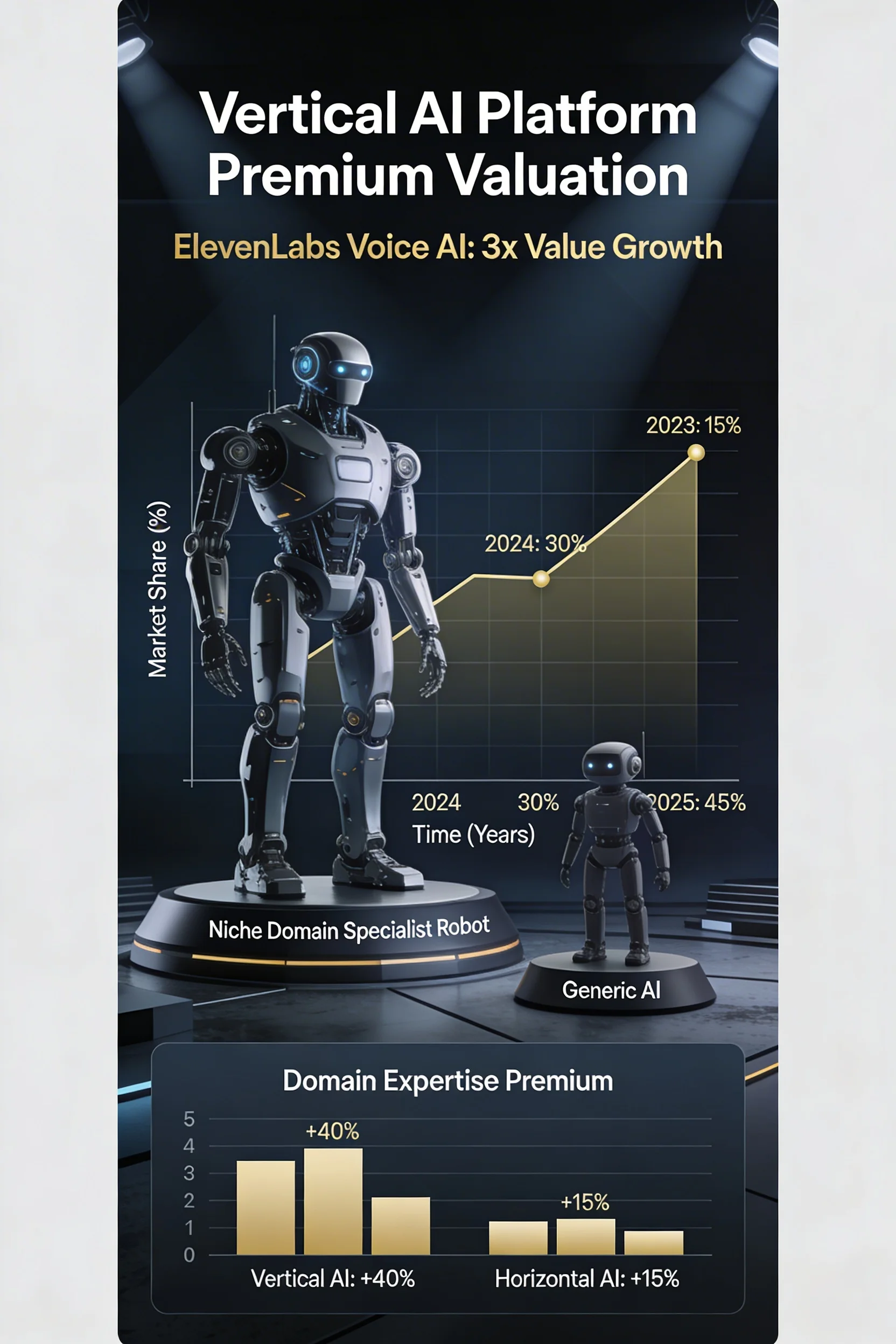
ElevenLabs went from a $1.1 billion valuation in January 2024 to $3.3 billion by the end of that year — a 3x increase in twelve months. The obvious narrative is that voice AI was hot and ElevenLabs was the leader. The more interesting explanation lies in what drove that leadership and why it was difficult for general-purpose foundation model providers to replicate it.
ElevenLabs is not a foundation model company in the standard sense. They do not compete to be the most capable general language model. They compete to be the best voice synthesis platform — a specific, bounded domain with its own technical requirements, quality metrics, training data characteristics, and user workflow patterns. Their moat is not parameter count; it is years of accumulated domain-specific investment.
This is the vertical AI premium thesis, and it is playing out across more categories than the finance press has fully appreciated.
Why Vertical Beats General in Specific Contexts
General-purpose foundation models are extraordinary achievements. They can write code, draft legal documents, summarize research papers, and compose music — often at quality levels that are genuinely useful across all of those domains. For many users and many tasks, general-purpose capability is exactly what they need.
But general-purpose optimization has costs. When you train a model to be good at everything, you make specific compromises. The training data distribution is a compromise. The output format expectations are a compromise. The evaluation metrics used during training are a compromise. For tasks where the user has no specialized requirements, these compromises are fine — the general capability is good enough.
For users with specialized requirements, the compromises accumulate into real gaps.
A radiologist using an AI tool to assist with imaging analysis needs a model trained on medical imaging descriptions, familiar with the specific terminology and formatting conventions of radiology reports, calibrated to the error consequences of medical diagnosis (where false negatives and false positives have asymmetric costs), and designed around the specific workflow of a radiologist rather than a generic knowledge worker.
No general-purpose language model provides all of this. A specialized model, trained on radiology data with radiology-specific evaluation criteria and deployed with radiology-specific tooling, can provide it.
The Data Flywheel Advantage
The deepest structural advantage of vertical AI platforms is not what they know today — it is how quickly they accumulate future knowledge through their product usage.
When ElevenLabs users create voice samples, rate outputs, and provide feedback, that data is directly informative for the next generation of voice synthesis training. It contains signal that general-purpose model training cannot easily replicate: high-quality examples of voice synthesis quality, edge cases in specific languages and accents, user preference patterns that reveal what "good" means in voice synthesis contexts that are not captured in any publicly available dataset.
This data flywheel means that a vertical platform's moat deepens as it grows. More users generate more proprietary data, which improves the model, which attracts more users. The general-purpose providers can build voice features, but they cannot easily replicate years of proprietary voice training data accumulated through a product built specifically for that domain.
Which Domains Have the Strongest Vertical Premium
The vertical AI premium is not uniform across domains. Several factors determine how much premium a specific vertical supports:
| Factor | Description | Strong-Premium Examples |
|---|---|---|
| Specialized data requirements | Scarce, expensive, or expert-labeled training data | Medical imaging, legal analysis, financial modeling |
| High error costs | Mistakes are expensive; users pay for lower error rates | Financial advice, medical diagnosis, security auditing |
| Complex workflow integration | Deep integration with domain-specific professional workflows | Radiology case review, legal due diligence |
| Regulatory requirements | Compliance barriers favor compliant-by-design platforms | Healthcare, finance, defense |
Specialized data requirements: Domains where high-quality training data is scarce, expensive to collect, or requires domain expertise to label correctly support stronger moats. Medical imaging, legal document analysis, and financial modeling all have these characteristics. Consumer content creation does not — the training data is abundant and widely accessible.
High error costs: Domains where mistakes are expensive — financial advice, medical diagnosis, legal analysis, security auditing — create strong demand for specialized, reliable capabilities over general-purpose "good enough." Users in these domains will pay significant premiums for demonstrably lower error rates.
Complex domain workflow integration: Domains with well-defined professional workflows that AI needs to integrate with deeply — the specific ways radiologists move through a case, the specific steps in a legal due diligence process, the specific patterns in a software security audit — benefit from specialized tools that understand those workflows rather than generic tools that require the user to bridge the gap.
Regulatory requirements: Domains with significant compliance requirements (healthcare, finance, legal, defense) often cannot use general-purpose tools without extensive compliance review. Vertical platforms that have done the compliance work and built compliant-by-design architectures gain an entry advantage that is difficult to displace.
The Developer Platform as a Vertical
One of the more interesting applications of the vertical AI premium thesis is to developer tooling — which is technically a vertical market (software developers) but one with unusually large buying power, high adoption velocity, and strong network effects through open-source contribution and word-of-mouth.
Developer AI tools exhibit several characteristics that support a vertical premium:
- Deep domain knowledge requirements: Developers have highly specialized preferences and quality requirements. Code generation tools need to understand not just syntax but style conventions, security best practices, framework-specific patterns, and codebase-specific context. Generic writing assistance tools are not a substitute.
- High-value workflow integration: Developer workflows are extremely well-defined and tooled. An AI platform that integrates deeply with git, CI/CD, issue tracking, and the developer's editor creates switching costs that generic chat interfaces cannot match.
- Data flywheel from usage: Every code generation, review, and debugging interaction produces potentially valuable training signal — both for improving the model and for building organization-specific context.
- Strong word-of-mouth dynamics: Developers share tool recommendations aggressively within their professional networks. A tool that genuinely improves developer productivity spreads quickly without significant marketing investment.
This is the category where Neumar operates. The vertical focus is developers who need agentic AI capabilities deeply integrated with their development workflows — not the general-purpose assistant that can answer any question, but the specialized platform that understands codebases, speaks the language of software development, integrates with the tools developers already use, and can autonomously execute the kinds of multi-step tasks that consume developer time.
The vertical focus informs specific product decisions: the Tauri-based desktop architecture that enables deep integration with local development tools; the two-phase plan-then-execute model that mirrors how careful developers approach complex tasks; the Linear ticket-to-PR pipeline that understands the structure of software development workflows; and the MCP integration that connects to the specific tools and services developers use.
Evaluating the Vertical AI Premium: Questions Worth Asking
For investors and builders thinking about vertical AI, several questions help separate genuine vertical premiums from domain-flavored general products:
Is the specialization technical or cosmetic? A general-purpose model with a domain-specific system prompt and some fine-tuning on domain examples is not a true vertical product — it is a wrapper. True vertical products have domain specialization that goes deeper: training data, evaluation criteria, workflow integration, and output formats that reflect genuine domain expertise.
Is the data flywheel accumulating? The most durable moats come from proprietary data that compounds through usage. If a vertical platform's data advantage is static — a one-time fine-tuning job on a publicly available domain dataset — it is not a flywheel. If every user interaction generates proprietary signal that improves the product, the moat deepens over time.
What does customer success look like in this domain? The strongest vertical AI companies have exceptional customer success stories — not "it saved me some time," but "it changed the economics of our business." The specificity of the value proposition, tied directly to domain-specific outcomes, is a signal of genuine vertical depth.
The ElevenLabs story is repeatable across many domains. The companies that execute it well will command the premium multiples that the market is currently ascribing to the category leaders.