
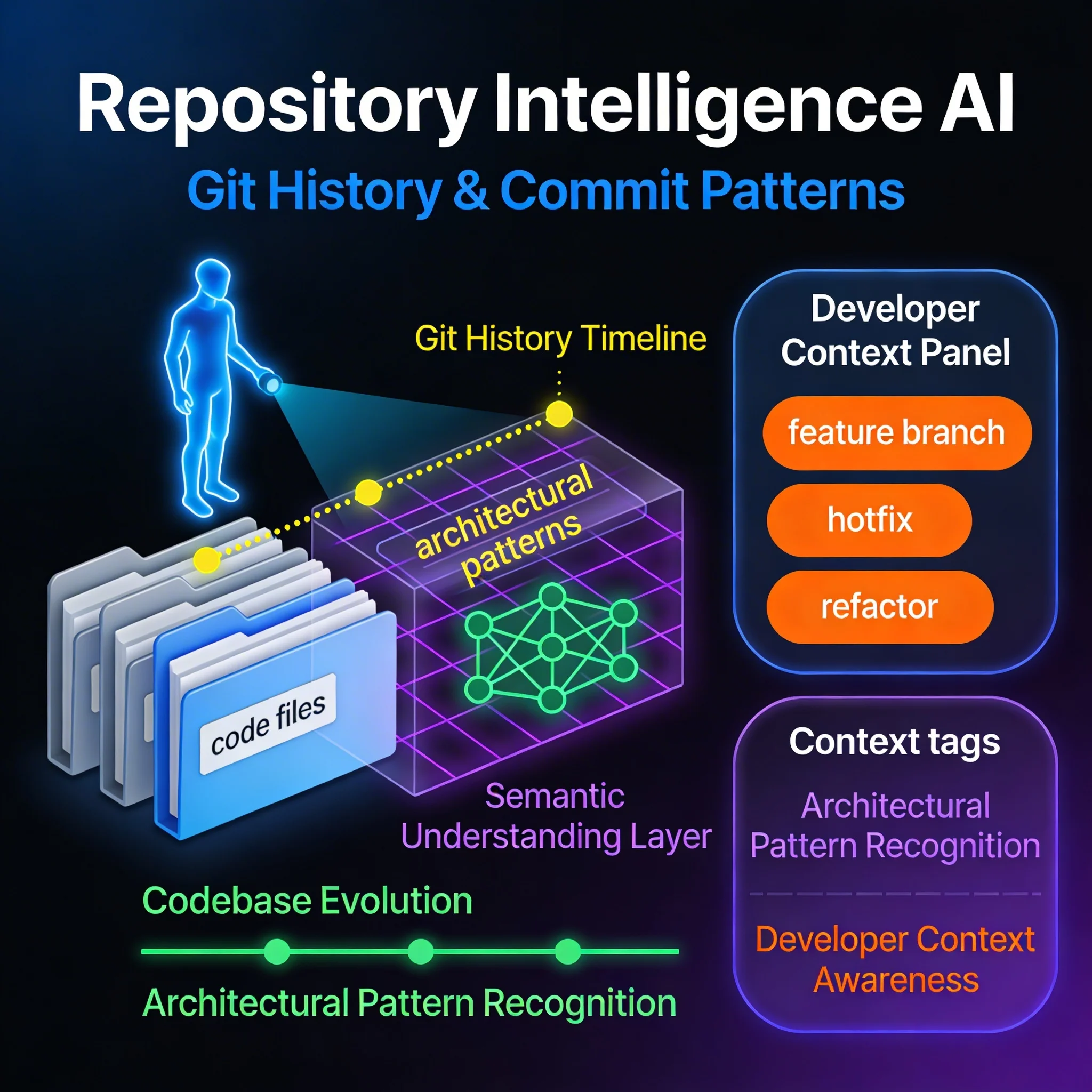
Reading source code is the least interesting thing an AI coding assistant can do. Any sufficiently capable language model can parse a TypeScript file and describe what it does. The harder and more valuable problem is understanding why the code is the way it is: what constraints shaped the original implementation, which abstractions were chosen deliberately and which are accidents of history, what the failed approaches were before the current one, and how the codebase has evolved in response to changing requirements.
This is the promise of repository intelligence — and the gap between that promise and what most tools actually deliver is still substantial, but closing faster than the marketing materials suggest.
What Repository Intelligence Actually Means
Repository intelligence is a composite of several distinct capabilities that are often conflated but work differently and have different value propositions.
Semantic code search is the baseline: the ability to answer "find all places where we handle rate limiting" by understanding intent rather than matching string patterns. This is solved, or at least well-approximated, by existing tools. It is necessary but not sufficient for genuine repository intelligence.
Architectural pattern recognition goes further. A tool with architectural intelligence can observe that the codebase uses a particular data access pattern consistently, that new modules follow a specific naming convention, or that service boundaries are organized according to a domain model that is not explicitly documented anywhere. This understanding allows the AI to generate code that follows existing conventions rather than importing patterns from its training data.
Historical context is where the genuinely interesting work is happening. Git history contains an enormous amount of information that is almost entirely ignored by current AI tools. Commit messages explain intent. PR descriptions explain the reasoning behind architectural choices. Code review comments record the alternatives that were considered and rejected. Reverted commits show approaches that did not work. This information is not in the source files themselves — it exists only in the repository's history.
Team convention inference is the ability to learn, from observed patterns rather than explicit documentation, how a particular team works. Which functions are tested with unit tests versus integration tests? How are error conditions handled? What is the conventional comment style? What naming patterns are used for similar constructs? A tool with genuine team convention awareness generates code that looks like it was written by the same team, not code that matches the model's training distribution.
The Representation Problem
Why don't current AI tools make better use of git history and PR context? The short answer is that the information exists but is not in a form that is easy to reason over.
A git history for a mature project contains thousands of commits, hundreds of PRs, and potentially years of review comments. Naively chunking this into a vector database and retrieving the most semantically similar chunks produces poor results because historical context is most useful when it is associated with specific code artifacts, not retrieved as free-floating text snippets.
The useful representation of repository history is entity-linked: commit A changed function B for reason C, which was the accepted resolution of design debate D that occurred in PR E. Reconstructing this graph from raw git data requires significant processing — parsing commit messages with NLP, linking commits to their changed files and functions, associating PR review threads with the code changes they discuss, and building a structured knowledge graph over the result.
A few specialized tools are building this layer. The results are compelling in demos and increasingly useful in practice, though the quality still varies significantly based on how well-maintained the repository's git hygiene is. A project with thorough PR descriptions and meaningful commit messages yields much richer context than one with "fix" and "wip" as the dominant commit message vocabulary.
How Existing Tools Handle Context Today
| Tool | Code Search | Cross-file Awareness | Git History / PR Context | Context Style |
|---|---|---|---|---|
| GitHub Copilot | Semantic (workspace) | Open files + project structure | Minimal | Index-based |
| Cursor | Strong semantic | Cross-file relationships | Minimal | Synchronic (current state) |
| Claude Code | Direct file reading | Session-scoped | Manual (git log/blame as text) | On-demand |
GitHub Copilot's @workspace context and the related GitHub search integration bring repository awareness into the chat interface, but it is primarily semantic code search with some awareness of open files and the current project structure. It does not incorporate commit history or PR context in a meaningful way.
Cursor's codebase indexing is strong at the semantic code search level and understands cross-file relationships well. Its context is largely synchronic — understanding the current state of the codebase — rather than diachronic — understanding how it got there.
Claude Code's approach is to read files directly during a session rather than relying on a pre-built index. This means it can look at git log and git blame output as raw text, and with the right prompt it can incorporate historical context — but the burden of what history to include and how to interpret it falls largely on the developer.
The gap between "can look at git history if prompted" and "understands the repository's evolution as background context" is significant, and no tool has fully closed it as of late 2025.
The Memory Layer as Repository Intelligence Proxy
One practical approach to the repository intelligence problem is using an agent's long-term memory system as a proxy for accumulated project context. Rather than reconstructing the repository's history from git data on demand, the agent builds its understanding of the project incrementally across sessions — noting architectural decisions, recording the reasoning behind significant changes, and maintaining a model of the project's conventions from direct observation.
This is how Neumar's memory system functions in development contexts. Across multiple sessions working on the same project, the agent accumulates a structured understanding of the codebase that goes beyond what any single git-history parsing pass would produce. It knows that the authentication module was recently migrated to a new provider and the old one should not be referenced in new code. It knows that the test suite uses a custom fixture pattern that differs from what the model would generate naively. It knows that the current architecture has a planned refactor and new code should accommodate the future state rather than reinforcing the current one.
This is not the same as git history analysis — it is observation-based rather than reconstruction-based. But it provides much of the practical value of repository intelligence for ongoing project work, at lower implementation cost and with higher reliability than current automatic history analysis.
Why This Matters for Code Quality
The gap between code that is syntactically correct and idiomatic versus code that fits its specific context is the gap between AI assistance that is useful and AI assistance that is genuinely high-leverage.
When an AI tool generates code that violates the conventions of its target codebase, the resulting review and correction work erodes much of the productivity gain. Developers reviewing AI-generated code in a mature codebase consistently report that the biggest time cost is not checking for logical errors — it is correcting convention violations, adjusting to project-specific patterns, and removing idioms that are perfectly standard in general but wrong for this specific context.
Repository intelligence, properly implemented, addresses this directly. An AI that understands why the codebase looks the way it does generates code that fits, rather than code that needs to be reshaped to fit.
The Near-Term Trajectory
The tools working on this problem are converging on a few approaches: structured knowledge graphs over git history, entity-linked retrieval that associates historical context with specific code artifacts, and hybrid systems that combine pre-built indexes with session-level accumulation.
The developers and teams that will benefit most are those who already treat their git history as a first-class artifact — writing meaningful commit messages, maintaining thorough PR descriptions, and using code review as a genuine reasoning forum rather than a rubber-stamp process. For them, the repository's history is already rich enough to support genuine intelligence extraction. For teams with minimal git hygiene, the gains will be more modest until the underlying record is improved.
Repository intelligence is not a solved problem in 2025. But the direction is clear, the tools are improving, and the value of the capability — when it works — is significant enough that it will continue to receive serious investment.