
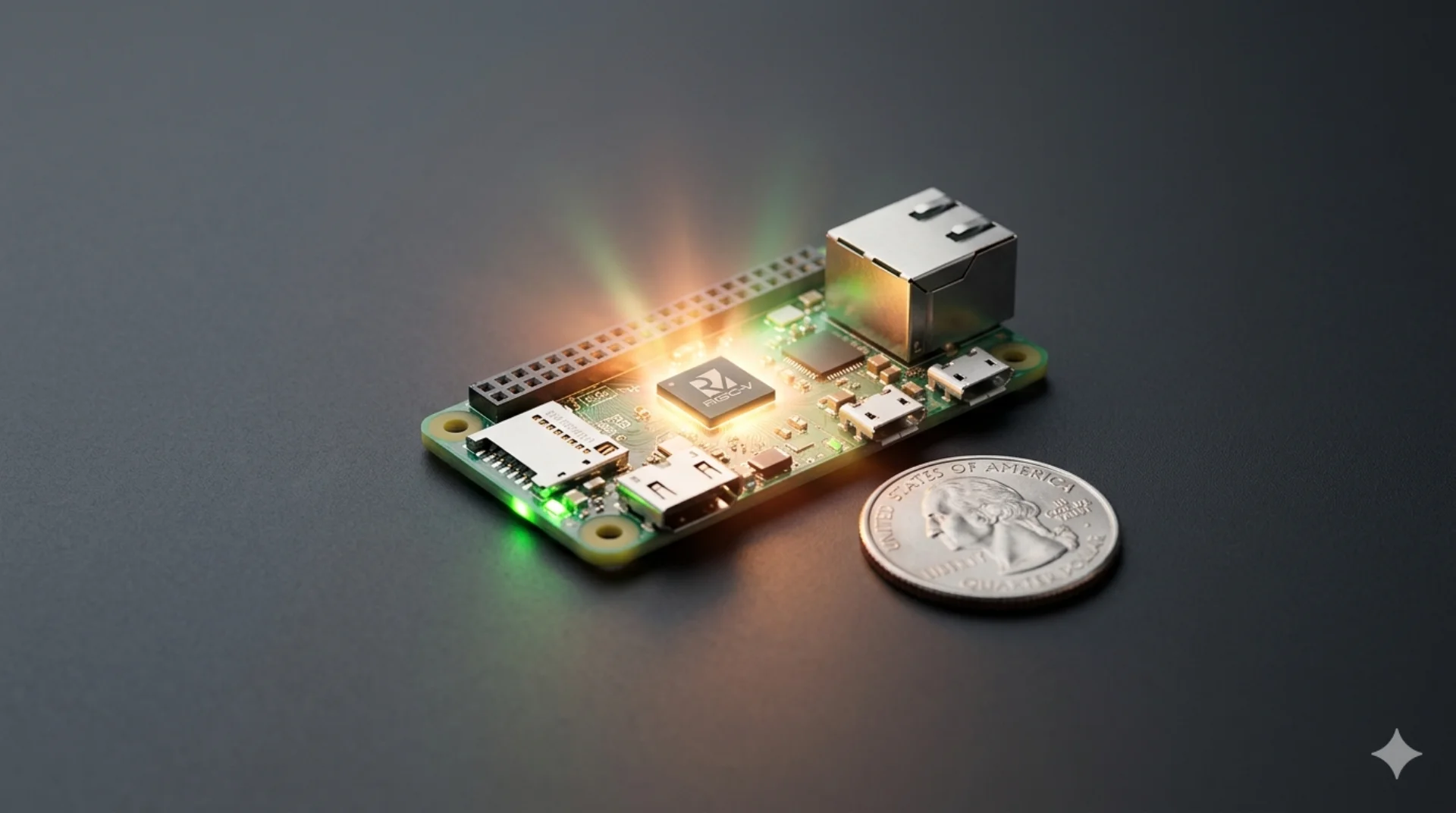
Most conversations about AI agents assume a certain minimum infrastructure: a capable machine, reliable internet, API access to a frontier model. PicoClaw challenges that assumption from the foundation. Built by Sipeed, the Shenzhen-based RISC-V hardware company, PicoClaw is an AI agent framework written in Go that runs on hardware costing as little as $10, boots in under one second, and can operate completely offline using a built-in model inference engine.
The project gained 17,000 GitHub stars within eleven days of its February 9, 2026 launch. That adoption velocity, while impressive, understates the significance. PicoClaw is not competing with OpenClaw for the same user base. It is defining a new category: AI agents at the edge, on hardware that was previously too constrained for any form of AI interaction.
The Numbers That Matter
| Specification | PicoClaw | OpenClaw | ZeroClaw |
|---|---|---|---|
| Language | Go | Node.js | Rust |
| Binary size | ~10 MB | ~200+ MB (with dependencies) | ~3.4 MB |
| RAM usage | <10 MB | ~256 MB+ | <5 MB |
| Boot time | <1 second | Several seconds | <10 ms |
| Min hardware | $10 SBC, 64 MB RAM | Modern desktop/server | Modest server/VPS |
| Offline operation | Yes (PicoLM) | No | No |
| Architectures | x86_64, ARM64, RISC-V, MIPS | x86_64, ARM64 | x86_64, ARM64 |
The Go binary is self-contained — no runtime dependencies, no package manager, no configuration files beyond a single picoclaw.yaml. This matters for deployment on embedded devices where package management infrastructure does not exist.
PicoLM: On-Device Inference
PicoClaw's most technically distinctive component is PicoLM — a purpose-built inference engine written in approximately 2,500 lines of C11 that runs TinyLlama 1.1B models in GGUF format directly on the device. No cloud API. No separate model server. No internet connection required.
The engineering constraints that PicoLM operates under are instructive:
256 MB RAM ceiling. PicoLM is designed to run TinyLlama 1.1B (quantized) on devices with as little as 256 MB of total system RAM. This requires careful memory mapping and layer-by-layer computation rather than loading the entire model into memory.
0.6 GHz single-core execution. PicoLM targets hardware running at 0.6 GHz on a single CPU core. The inference speed is not fast — but it is functional. For tasks where latency tolerance is measured in seconds rather than milliseconds (checking a sensor reading, responding to a message, scheduling a reminder), it is adequate.
Structured output. PicoLM auto-activates a JSON grammar mode (--json) that constrains the model's output to valid JSON for tool calling. This is essential because smaller models are significantly less reliable at producing valid structured output without constraints. The grammar mode ensures that tool calls from a 1.1B parameter model are syntactically valid, even when the model's reasoning is less reliable than a frontier model.
The practical result is that PicoClaw with PicoLM can run a functional AI agent loop — receive a message, reason about it, call tools, respond — on a $10 single-board computer with no internet connection. The reasoning quality is lower than Claude or GPT, but for simple, well-defined tasks (timer management, sensor monitoring, local file organization, basic Q&A from a local knowledge base), it is sufficient.
Architecture
PicoClaw's architecture mirrors the agent loop pattern used by larger frameworks but optimizes aggressively for minimal resource usage:
Message Input (Telegram/Discord/Slack/QQ)
         ↓
┌────────────────────────┐
│    PicoClaw Agent      │
│                        │
│  ┌──────────────────┐  │
│  │  LLM Provider    │  │
│  │  - PicoLM (local)│  │
│  │  - OpenRouter     │  │
│  │  - Anthropic      │  │
│  │  - DeepSeek       │  │
│  └──────────────────┘  │
│                        │
│  ┌──────────────────┐  │
│  │  Tools           │  │
│  │  - File ops      │  │
│  │  - Shell exec    │  │
│  │  - Web search    │  │
│  │  - Cron/schedule │  │
│  └──────────────────┘  │
│                        │
│  ┌──────────────────┐  │
│  │  Memory (SQLite) │  │
│  └──────────────────┘  │
└────────────────────────┘
Messaging channels support Telegram, Discord, Slack, QQ, DingTalk, and WeCom. The agent appears as a bot on the platform and processes messages asynchronously.
LLM providers are configurable. When internet is available, PicoClaw can route to any supported cloud provider (OpenRouter, Anthropic, Google Gemini, DeepSeek, Groq, Zhipu). When offline, PicoLM handles inference locally. The provider can be switched dynamically based on connectivity.
Built-in cron supports one-time reminders, recurring tasks, and standard cron expressions. This is a native capability, not an MCP server — reflecting the constraint that MCP servers add memory overhead that may be unacceptable on target hardware.
Session persistence via SQLite ensures that conversation history and memory survive restarts. On devices that reboot frequently (power management, hardware resets), this is essential for maintaining useful agent behavior across sessions.
Use Cases That the Edge Enables
PicoClaw's resource profile opens use cases that are impractical or impossible with cloud-dependent agents:
Repurposed old devices. An old Android phone, a retired laptop, a first-generation Raspberry Pi — any device with 64 MB of free RAM and a network connection (or PicoLM for offline) can become a personal AI assistant. The environmental and economic case is straightforward: instead of discarding obsolete hardware, give it a useful second life.
Air-gapped environments. Industrial facilities, classified networks, and high-security environments that cannot connect to cloud services can still benefit from AI assistance using PicoLM's local inference. The reasoning quality is limited, but for structured tasks with clear parameters, it provides genuine value.
IoT and sensor networks. An AI agent running on an edge device can process sensor data, make decisions based on local context, and only communicate results to the network — rather than streaming raw data to the cloud for processing. This reduces bandwidth requirements and latency while keeping sensitive data local.
Developing markets. In regions where internet connectivity is expensive, unreliable, or censored, a local-first agent that works offline provides AI capabilities that cloud-only services cannot.
The 95% AI-Generated Codebase
A notable aspect of PicoClaw's development is that approximately 95% of the core codebase was generated by AI through a self-bootstrapping process, with human-in-the-loop review. The project was inspired by NanoBot and refactored from the ground up in Go using AI-assisted development.
This is a practical demonstration of the AI coding workflow at scale: an AI agent framework whose code was largely written by AI agents. The human contribution was architectural direction, review, and the specialized components (PicoLM's C11 inference engine) where AI-generated code was not reliable enough.
Current Limitations
PicoClaw is pre-v1.0 and the maintainers explicitly warn against production deployment. Known issues include:
Network security. The project documentation notes unresolved network security issues that make it unsuitable for exposure to untrusted networks. This is critical for IoT deployment scenarios.
MCP support not yet available. The March 2026 roadmap includes MCP protocol support as a planned feature, but it is not yet implemented. This limits PicoClaw's extensibility compared to OpenClaw's 3,200+ ClawHub skills.
PicoLM reasoning quality. TinyLlama 1.1B, even with structured output constraints, produces significantly lower quality reasoning than frontier models. Complex multi-step tasks that require nuanced judgment are beyond its capability.
Limited testing on RISC-V and MIPS. While these architectures are supported in the build system, community testing has been concentrated on ARM64 and x86_64.
Roadmap (March 2026)
The published Phase 1 roadmap includes:
| Feature | Status | Description |
|---|---|---|
| Agent Loop 2.0 | Planned | Lower latency reasoning loop |
| Swarm | Research | Multi-device coordination across PicoClaw instances |
| MCP Support | Planned | Model Context Protocol integration |
| ByteDance Volcengine | Planned | Additional LLM provider |
| Setup Wizard | Planned | Simplified first-run configuration |
The "Swarm" research item is particularly interesting: coordinating multiple PicoClaw instances across devices to distribute tasks and share results. This would enable collective intelligence from a network of cheap edge devices — a pattern that has theoretical appeal but significant engineering challenges in practice.
References
- PicoClaw GitHub repository
- PicoClaw official site
- Hackster.io, "Forget the Mac Mini — Run This OpenClaw Alternative for Just $10"
- CNX Software, "PicoClaw ultra-lightweight AI assistant runs on just 10MB of RAM"
- PicoLM GitHub repository
- HuggingFace Blog, "PicoClaw, PicoLM, and Edge AI"
- PicoClaw March 2026 Roadmap
- BaristaLabs, "PicoClaw AI Agent Framework"