
When Peter Steinberger published his Telegram bot project in November 2025, the initial reaction was muted. Another chat-based AI assistant, another open-source weekend project. Three months and two name changes later, OpenClaw had 247,000 GitHub stars, 47,700 forks, and had triggered security warnings from China's national cybersecurity agency. AWS launched a managed hosting service for it. Sam Altman hired its creator.
Understanding how this happened requires looking at what OpenClaw actually does differently at the architecture level, rather than treating it as another chatbot wrapper.
The Core Architecture: Three Layers, One Principle
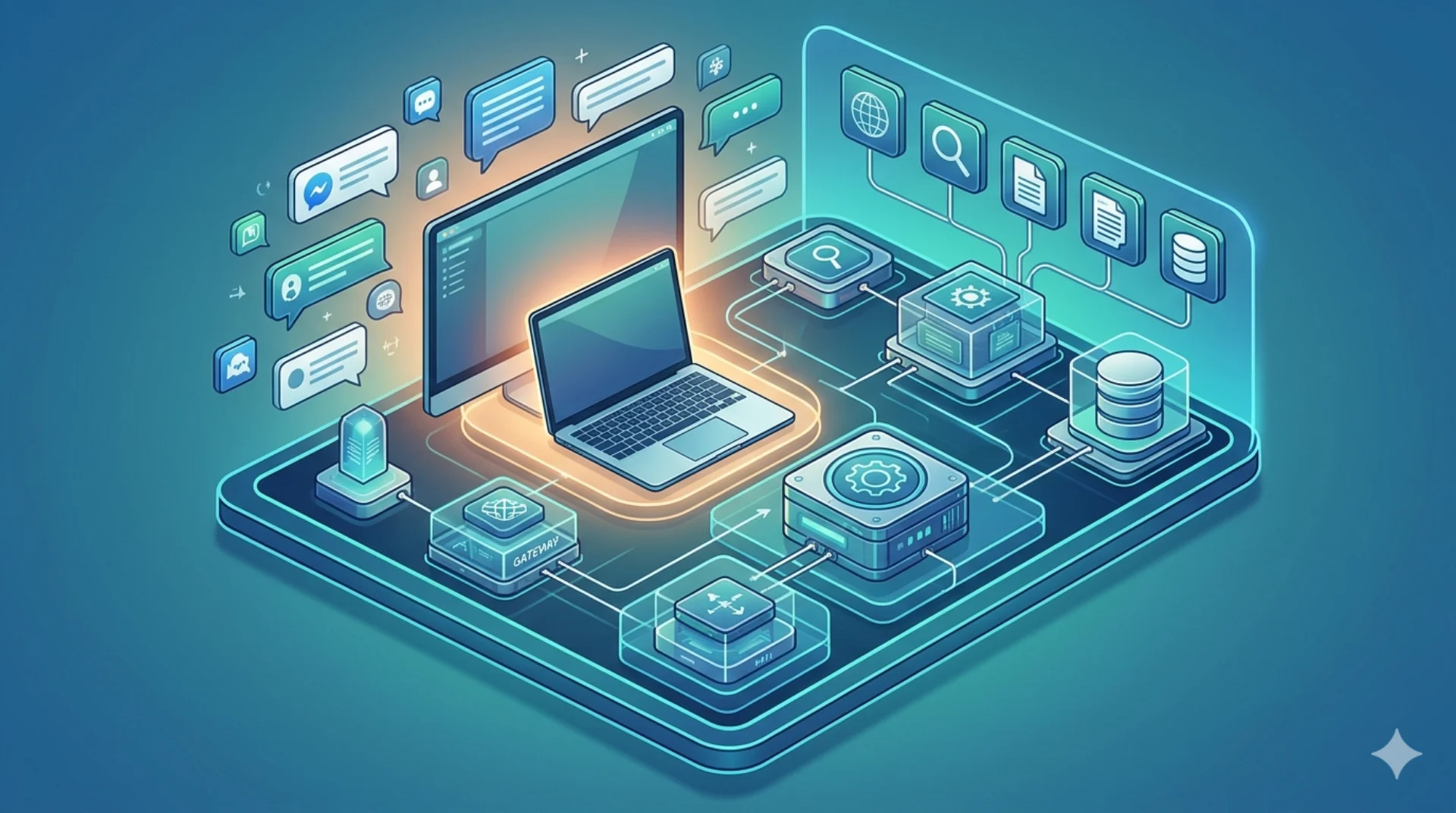
OpenClaw's architecture follows a simple organizing principle: the user's machine is the execution environment, messaging platforms are the interface, and the LLM is a replaceable reasoning engine. Every design decision flows from this.
Gateway Daemon. An always-on service that manages WebSocket connections to messaging platforms (Telegram, WhatsApp, Signal, Discord), routes incoming messages to the correct agent session, and handles authentication and session lifecycle. The daemon runs as a background process on the user's machine — not in the cloud. This is the "local-first" commitment made concrete in infrastructure.
Agent Runtime. The reasoning loop that connects the LLM to tools, memory, and skills. The runtime receives a user message from the gateway, constructs a prompt with relevant context and available tools, sends it to the configured LLM, parses tool calls from the response, executes them locally, and loops until the agent produces a final response. This is architecturally similar to the agent loops in Claude Agent SDK and LangChain — the difference is where it runs and what it has access to.
Messaging Interface. Rather than building a custom UI, OpenClaw treats existing chat platforms as its frontend. This was a critical design decision. Users interact with their AI agent through the same apps they already use for human communication. The agent appears as a contact in Telegram or a bot in Discord, not as a separate application.
┌─────────────────────────────────────────────┐
│                User's Machine               │
│                                             │
│  ┌──────────┐   ┌──────────────────────┐   │
│  │ Gateway  │──▶│    Agent Runtime     │   │
│  │ Daemon   │   │  ┌────────────────┐  │   │
│  │          │   │  │  LLM Provider  │  │   │
│  │ WebSocket│   │  │ (Claude/GPT/   │  │   │
│  │ to Chat  │   │  │  DeepSeek)     │  │   │
│  │ Platforms│   │  └────────────────┘  │   │
│  └──────────┘   │  ┌────────────────┐  │   │
│                 │  │  MCP Servers   │  │   │
│                 │  │  (3,200+ on    │  │   │
│                 │  │   ClawHub)     │  │   │
│                 │  └────────────────┘  │   │
│                 └──────────────────────┘   │
└─────────────────────────────────────────────┘
MCP Integration: The Skill Ecosystem
OpenClaw's most consequential technical decision was adopting MCP as its primary extensibility mechanism from the start. The agent runtime includes native MCP client support using @modelcontextprotocol/sdk, with a well-defined lifecycle:
- Initialization: Capability negotiation handshake with each configured MCP server
- Discovery: Enumerating available tools, resources, and prompts
- Invocation: JSON-RPC calls over stdio or SSE transport
MCP servers are configured in openclaw.json, and the community-maintained ClawHub hosts over 3,200 skills organized across dozens of categories — from database drivers to email management to calendar operations.
This matters because it means OpenClaw did not need to build integrations for every service its users wanted to connect to. The MCP ecosystem provided them. When a developer publishes a new MCP server for a service, every OpenClaw installation can use it without a product update.
LLM Agnosticism as Architecture
OpenClaw wraps LLM interactions behind a provider interface that supports Claude, GPT models, DeepSeek, and any OpenAI-compatible API endpoint. The practical effect is that users can switch between models based on cost, capability, or data residency requirements without changing their agent configuration.
This is architecturally significant because it means OpenClaw's value is in the orchestration and execution layer, not in the model layer. The agent runtime, the tool execution environment, the session management, the MCP integration — these are all model-independent. The LLM is a component that gets swapped, not a foundation that everything depends on.
| Component | Technology | Purpose |
|---|---|---|
| Gateway Daemon | Node.js, WebSocket | Message routing, session management |
| Agent Runtime | Node.js | Reasoning loop, tool dispatch, memory |
| MCP Client | @modelcontextprotocol/sdk v1.25.3 | Tool discovery and invocation |
| LLM Providers | Claude, GPT, DeepSeek, others | Reasoning engine (pluggable) |
| Skill Registry | ClawHub (3,200+ servers) | Community-maintained tool ecosystem |
| Messaging | Telegram, WhatsApp, Signal, Discord | User interface layer |
Why 247K Stars in Three Months
The adoption trajectory is worth examining because it reveals what matters in open-source AI tooling. Several factors combined:
Low setup friction. A single install command, a Telegram bot token, and an API key for any supported LLM. The user has a working AI agent in under ten minutes. Contrast this with frameworks that require understanding orchestration concepts, configuring vector databases, and writing tool definitions.
Familiar interface. Using existing messaging platforms eliminates the "another app" barrier. Users do not need to learn a new interface or switch contexts to interact with their agent. The agent meets them where they already are.
Immediate utility. The combination of LLM reasoning with local system access means OpenClaw can do things that cloud-only AI assistants cannot: manage local files, run shell commands, interact with local services, and access data that never leaves the user's machine. For tasks like email triage, calendar management, and file organization, this local execution model provides both better capability and better privacy.
Community momentum. Once adoption passed a threshold, network effects accelerated it. More users meant more MCP servers on ClawHub, which meant more capability for every user, which attracted more users. The skill ecosystem grew faster than any single team could have built it.
The Name Problem and Its Resolution
OpenClaw's naming history is instructive about the trademark landscape in AI. Originally published as "Clawdbot" — an obvious reference to Claude — Anthropic's legal team sent a cease-and-desist. The project renamed to "Moltbot" on January 27, 2026, then to "OpenClaw" three days later when the community settled on a name that was distinct enough to avoid trademark issues while retaining the crustacean branding that had become part of the project's identity.
The "lobster" identity stuck. When OpenClaw went viral in China in March 2026, the local adoption movement was branded as "raise a lobster" — a phrase that became a cultural phenomenon extending well beyond the technical community.
What OpenClaw Reveals About the Agent Platform Landscape
OpenClaw's success validates several architectural bets that are relevant to anyone building or evaluating AI agent platforms:
Local execution wins on privacy and capability. Cloud-only agents have a fundamental limitation: they cannot access local systems without complex tunneling or API exposure. Local-first agents have access to everything on the user's machine by default.
Protocol-based extensibility scales better than plugin architectures. MCP provided OpenClaw with a skill ecosystem that grew faster than any team could have curated. The lesson is that adopting an open protocol for tool integration is more valuable than building a proprietary plugin system.
Messaging-native interfaces reduce adoption friction. The decision to use existing chat platforms rather than building a custom UI eliminated one of the most common barriers to developer tool adoption: learning a new interface.
These are not unique insights, but OpenClaw is the clearest demonstration to date that executing on all three simultaneously produces compounding adoption effects that are difficult to replicate with any single advantage.
Adoption Timeline
| Date | Event | Impact |
|---|---|---|
| November 2025 | Published as "Clawdbot" | Initial release, modest interest |
| January 27, 2026 | Renamed to "Moltbot" (Anthropic trademark) | Brief disruption, increased visibility |
| January 30, 2026 | Renamed to "OpenClaw" | Final branding settled |
| Early February 2026 | Viral growth begins | 2M visitors/week at peak |
| February 14, 2026 | Steinberger joins OpenAI | Foundation announced, OpenAI backing |
| March 2026 | "Raise a lobster" phenomenon in China | Government incentives, 200K+ active installations |
| March 10-14, 2026 | CNCERT security warnings issued | State enterprises barred from use |
References
- OpenClaw GitHub repository
- OpenClaw official site
- DigitalOcean, "What Is OpenClaw AI?"
- TechCrunch, "OpenClaw creator Peter Steinberger joins OpenAI" (February 15, 2026)
- Bloomberg, "What Is the OpenClaw AI Agent and Why Is It Popular in China?" (March 11, 2026)
- SafeClaw, "OpenClaw MCP Integration Guide"
- OpenClaw - Wikipedia