
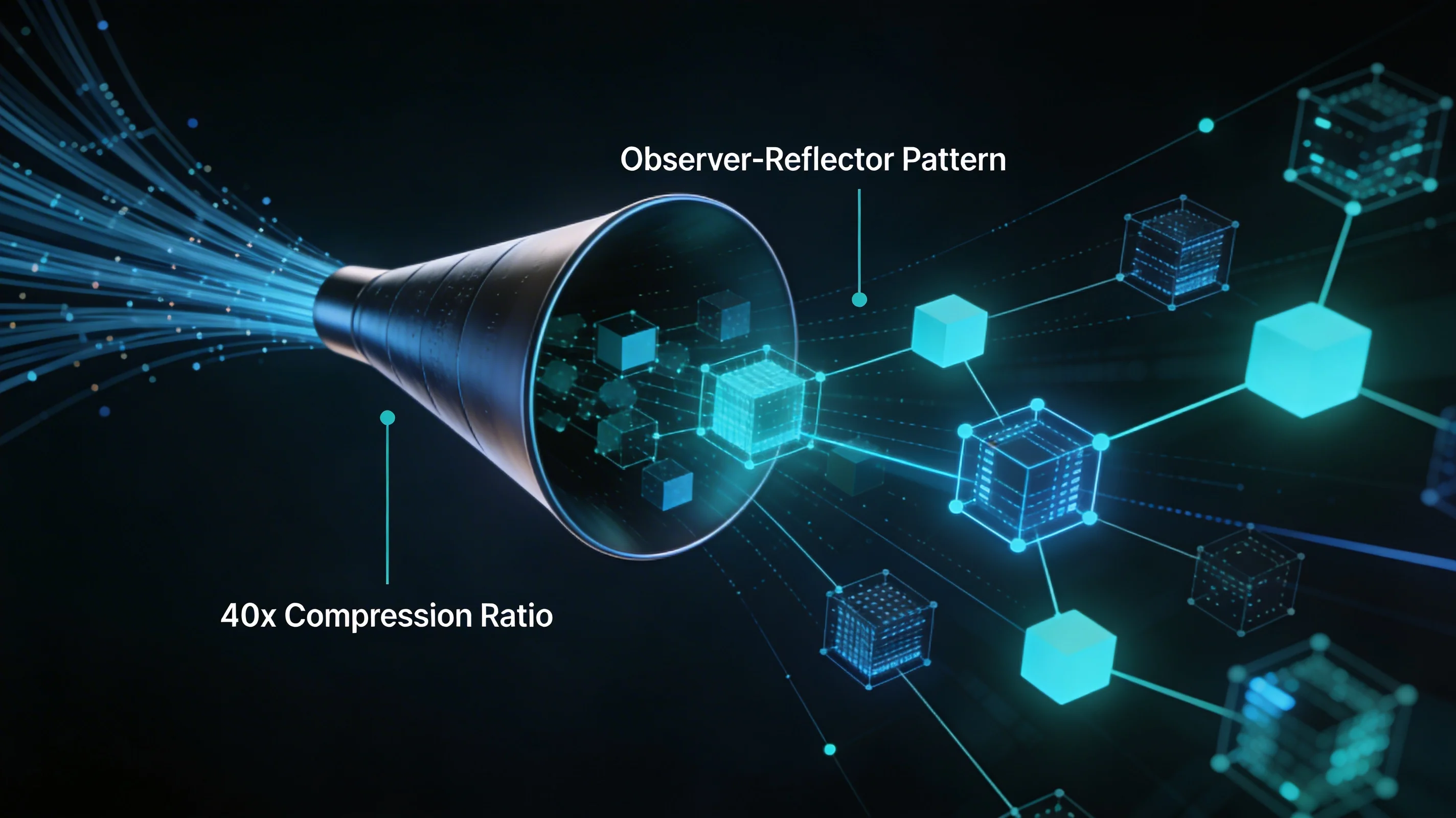
The dominant approach to giving AI agents long-term memory has been some variant of Retrieval-Augmented Generation: capture raw content, embed it into a vector store, and retrieve relevant chunks at query time. RAG has genuine strengths — it handles large document corpora well, it is relatively simple to implement, and it pairs naturally with the retrieval-oriented thinking most ML practitioners already have.
But RAG has a structural mismatch with how agent memory actually needs to work. Documents are the right unit for a knowledge base. They are the wrong unit for an agent's experiential memory. The difference matters more than it might initially seem, and it explains why a different architecture — the Observer-Reflector pattern — achieves dramatically better compression ratios while retaining higher-quality context for agent operation.
What RAG Gets Wrong About Agent Memory
A RAG system optimizes for one thing: given a query, retrieve the text chunks most likely to contain a relevant answer. This is exactly what you want when building a question-answering system over a document corpus. It is a poor fit for the memory requirements of an agent that executes tasks over time.
Agent memory serves different purposes than document retrieval. It needs to answer questions like: What has this user asked me to do before? What approaches did we try that failed? What are the user's preferences and working style? What do I know about the current project's architecture? What commitments have I made?
These questions are not answered well by retrieving raw chunks of past conversation transcripts. A transcript chunk from three weeks ago contains a mixture of relevant and irrelevant content, expressed in a conversational register that is verbose relative to the information density needed for agent planning. Retrieving ten transcript chunks to reconstruct a single user preference is wasteful and introduces noise.
The deeper problem is that RAG systems are passive. They store whatever they are given and retrieve whatever seems relevant. They do not synthesize, compress, or draw higher-order conclusions. Two months of agent interactions contain patterns — recurring goals, persistent preferences, domain-specific conventions — that are invisible to a system that only retrieves surface-level matches.
The Observer-Reflector Architecture
The Observer-Reflector pattern addresses these limitations by treating memory as an active pipeline rather than a passive store. It consists of two distinct components operating on different timescales.
The Observer runs continuously alongside the agent, monitoring interactions and making real-time decisions about what is worth capturing. Not everything the agent does is worth remembering. Routine tool calls, transient clarifications, and exploratory steps that led nowhere do not need permanent storage. The Observer applies a set of significance heuristics — detecting when user preferences are expressed, when task outcomes are determined, when novel information about the environment is established — and writes structured memory records for the events that clear those thresholds.
The key difference from RAG ingestion is that the Observer writes structured records, not raw text. A user preference is stored as {entity: "user", attribute: "preferred_language", value: "TypeScript", confidence: 0.9, last_confirmed: timestamp} — not as a chunk of a conversation in which the preference was mentioned. This structural representation is far more compact and queryable than the raw source material.
The Reflector runs periodically — after a task session ends, or on a scheduled background cycle — and performs higher-order synthesis over accumulated observations. Where the Observer writes individual facts, the Reflector identifies patterns across facts, resolves contradictions between observations made at different times, and constructs abstractions that could not be derived from any single interaction. The Reflector output is stored separately as reflective memory — a layer of synthesized understanding that sits above raw observations.
The Compression Story
The 40x compression figure comes from comparing storage and retrieval costs between a standard RAG implementation and an Observer-Reflector system operating on the same interaction history.
A typical hour of productive agent interaction generates somewhere between 20,000 and 80,000 tokens of raw content — conversation turns, tool call logs, intermediate reasoning, document snippets. Stored naively in a vector database, this requires embedding and indexing the full content.
The Observer-Reflector approach yields a very different storage profile. A one-hour session that generates 50,000 tokens of raw content might produce:
| Component | Count | Avg Tokens Each | Total Tokens |
|---|---|---|---|
| Raw content (RAG approach) | 1 session | 50,000 | 50,000 |
| Structured observations | 15-30 records | 40 | 600-1,200 |
| Reflective summaries | 3-5 summaries | 200 | 600-1,000 |
| Observer-Reflector total | 1,200-2,200 |
Total stored representation: roughly 1,200-2,200 tokens, compared to 50,000 tokens for the raw content. That is approximately a 25-40x compression ratio -- arriving at the cited 40x figure on the higher end of interaction density.
The more important question is whether this compression preserves the right information. For document retrieval tasks, aggressive compression loses material. For agent operational memory — preferences, patterns, outcomes, commitments — the structured representation is actually more useful than the raw content because it isolates the signal from the conversational noise.
Recall Quality Under Compression
Compression only matters if recall quality holds up. The counterargument to aggressive memory compression is that you lose nuance: the exact phrasing a user used, the specific context that shaped a preference, the hedges and qualifications that surround a stated preference.
Observer-Reflector systems handle this through a two-tier architecture. The structured observation records serve as the fast-path memory, sufficient for the majority of operational queries. When a query requires the original context — when an agent needs to verify a subtle point or the original phrasing matters — the system can retrieve the raw source material from a cold store, using the observation record as a precise pointer rather than a fuzzy semantic query.
This pointer-based retrieval is substantially more accurate than standard RAG retrieval for contextual material, because the Observer already identified the relevant source at capture time. The retrieval step is deterministic rather than approximate.
Neumar's Memory Implementation
Neumar's long-term memory system is built around the Observer-Reflector pattern with several implementation-specific extensions.
Auto-capture means the memory system operates without requiring explicit user interaction. There is no "save this" button. The Observer monitors every agent session and applies its significance heuristics automatically, building the memory store from normal working behavior.
The embedding layer is used for recall, not for primary storage. When an agent needs to surface relevant context at the start of a new session, it queries the structured memory store using a combination of semantic similarity (over the observation summaries) and structured attribute lookups (for specific entities and preferences). This hybrid retrieval is faster and more precise than pure vector retrieval over raw content.
Confidence scoring on observations means that the memory system tracks how certain it is about each stored fact. A preference observed once gets a lower confidence score than one that has been confirmed across multiple sessions. When the Reflector resolves contradictions between observations, it weights more recent and higher-confidence records appropriately rather than treating all past observations as equally authoritative.
The SQLite-backed local storage means the entire memory system operates without external dependencies. Memory does not leave the user's machine, and the system functions identically offline. For a desktop application handling sensitive work, this privacy architecture is not incidental — it is a core design requirement.
When RAG Is Still the Right Choice
The Observer-Reflector pattern is optimized for agent operational memory. For knowledge base retrieval — when an agent needs to answer questions against a large corpus of documents the user has explicitly provided — RAG remains appropriate and in some ways superior. The documents in a knowledge base are not agent interaction history; they are reference material that the user wants the agent to consult. They warrant different treatment.
A complete agent memory architecture often uses both approaches: Observer-Reflector for operational memory derived from agent sessions, and RAG for knowledge bases over user-supplied documents. The key is matching the architecture to the memory type rather than applying a single approach to both.
The persistence challenge for agent memory is not primarily a storage or retrieval problem. It is a curation problem: deciding what is worth remembering, at what level of abstraction, and with what confidence. RAG solves the retrieval problem. Observer-Reflector solves the curation problem. For agents that operate over time on complex, contextual tasks, curation is the harder and more important problem to get right.