
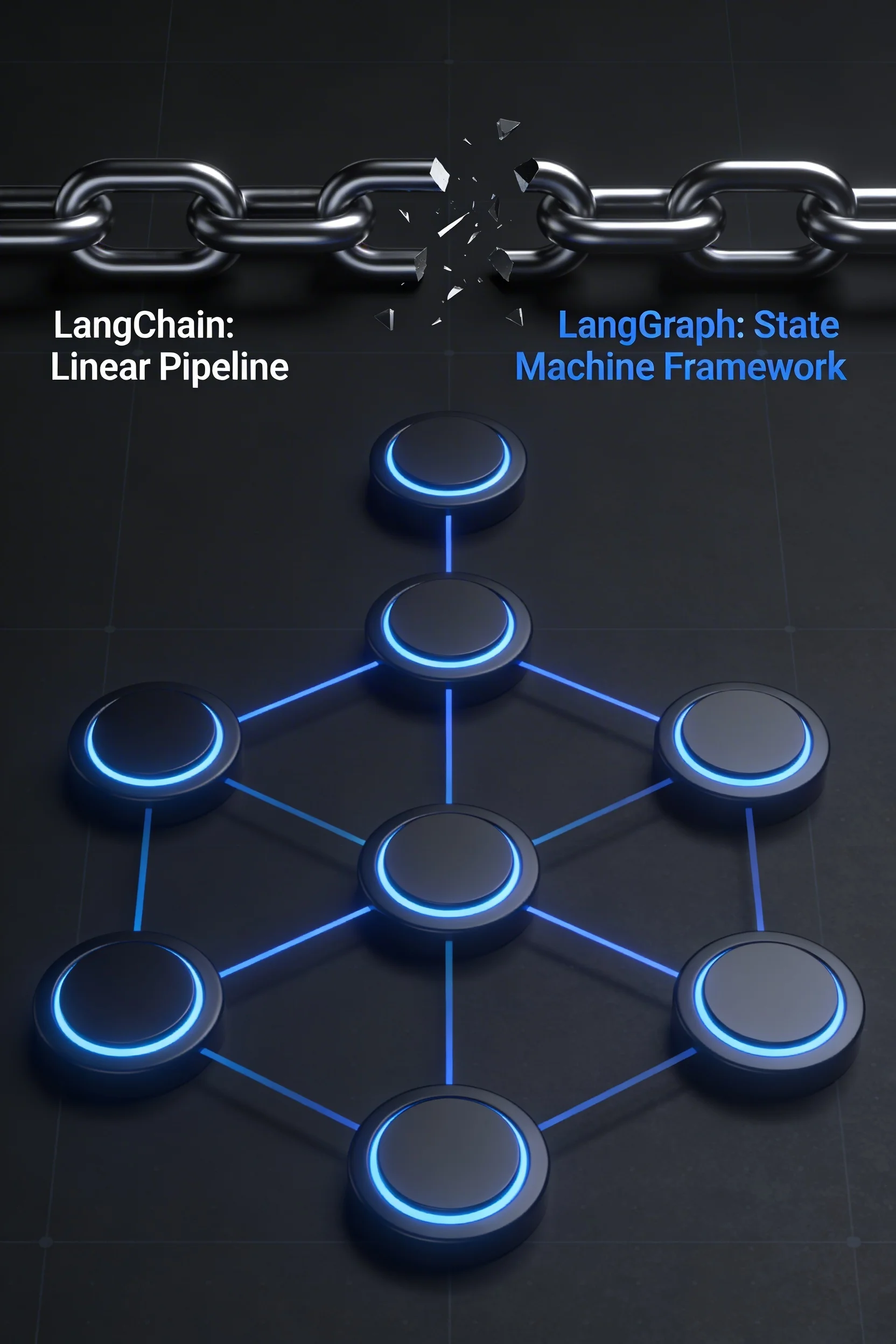
LangChain occupies a peculiar position in the AI development ecosystem. It was the framework that more teams used to build their first AI application than perhaps any other tool. It was also the framework more teams outgrew — abandoning its abstractions when they proved too leaky for production use — than perhaps any other tool. The company is now in the middle of a strategic pivot that acknowledges what critics said all along: chains were the wrong primitive for complex agents.
LangGraph is the replacement thesis. And unlike most framework migrations, this one comes with a genuine intellectual shift in how its creators think about agent orchestration.
Why the Original Abstractions Broke Down
LangChain's original design organized agent behavior into chains — sequential compositions of LLM calls, tool invocations, and transformations. The mental model was pipeline: data flows in, gets processed, flows out. You could branch the pipeline, but the fundamental structure was linear.
This worked well for simple workflows. It worked poorly as soon as agents needed to:
| Requirement | LangChain (Chains) | LangGraph (Graphs) |
|---|---|---|
| Parallel subtasks | Not natively supported | Send pattern for dynamic fan-out |
| Revisit earlier decisions | Difficult to backtrack | Graph edges allow cycles |
| Shared mutable state | Implicit, error-prone | Explicit Annotation.Root schema |
| Human-in-the-loop review | No built-in support | Checkpointing with pause/resume |
| Partial failure recovery | Restart from scratch | MemorySaver checkpointing |
- Execute subtasks in parallel and then recombine results
- Revisit earlier decisions when downstream steps failed
- Maintain shared state that multiple agent components could read and modify
- Pause for human review and resume after approval
- Handle partial failures gracefully without restarting from scratch
All of these requirements are extremely common in real production agent workflows. None of them fit naturally into a chain model.
The criticism that accumulated through 2023 and 2024 was that LangChain's abstractions made simple things simple but made the next level of complexity disproportionately hard. Teams would build proof-of-concept agents quickly, then spend weeks fighting the framework when they tried to add the reliability and sophistication that production required.
LangGraph's Different Primitive
LangGraph reframes agent orchestration around a directed graph where nodes are processing functions and edges are transitions. This is a more honest model of what complex agents actually do: they navigate states, make conditional decisions about what to do next, and sometimes revisit states they have already visited.
The key architectural decisions that make LangGraph work in production:
Explicit State Management
LangGraph's Annotation.Root system requires you to define your agent's state schema explicitly before you write any processing logic. Every node in the graph reads from and writes to this typed state object. The result is that state transitions are legible — you can look at a LangGraph definition and understand what data exists at any point in the workflow.
This seems like an obvious requirement, but it is one that LangChain's original chain abstraction didn't enforce. Implicit state passing through callback chains was a major source of debugging difficulty in early LangChain applications.
The Send Pattern for Parallel Execution
One of LangGraph's most powerful features is the Send pattern for dynamic fan-out. Rather than defining static parallel branches at graph construction time, a node can dynamically generate a list of Send objects at runtime — each spawning an independent worker with its own slice of state.
The canonical use case is research: if an agent needs to investigate ten topics in parallel, each producing a summary that gets aggregated at the end, the Send pattern handles this elegantly. The static graph definition doesn't need to know how many parallel workers will be spawned; that is determined by data at runtime.
Built-in Checkpointing
Long-running agent workflows that take minutes, hours, or days cannot afford to restart from scratch when something goes wrong. LangGraph's MemorySaver checkpointer stores the complete graph state after each node execution, enabling:
- Resumption after interruption or failure
- Human-in-the-loop review gates that pause execution until approval arrives
- Debugging replay from any intermediate state
- Time-travel inspection of how state evolved through the workflow
In practice, the checkpointing capability closes the gap between prototype and production more than almost any other feature. Agents without durable state checkpointing are fragile in ways that only reveal themselves at 3am.
How Neumar Leverages LangGraph
Neumar's architecture supports both Claude Agent SDK and LangGraph approaches, exposing them as complementary tools for different workflow shapes. This dual-support model reflects a real practical truth: not every agent task benefits from the same orchestration framework.
The Claude Agent SDK approach — which powers Neumar's core agent execution — excels at conversational, tool-calling workflows where the agent makes sequential decisions in response to a stream of observations. The two-phase plan-then-execute model maps naturally onto the SDK's sequential execution model: the agent first reasons about what it needs to do, then executes that plan step by step.
LangGraph shines for the subset of tasks that have genuinely parallel structure. Consider a codebase analysis workflow where the agent needs to simultaneously examine the database schema, the API routes, the test coverage, and the CI configuration, then synthesize all four perspectives into a coherent assessment. Running these four analyses sequentially takes four times as long as running them in parallel. LangGraph's fan-out model makes the parallel execution straightforward to implement and operationally reliable.
The Neumar backend implements LangGraph workflows using the Annotation-based state machine pattern, with MemorySaver checkpointing enabled by default for any workflow that is expected to take more than a few seconds. The checkpointing integrates with Neumar's persistent memory system, which means workflow state is accessible across sessions — you can inspect the intermediate state of a workflow that ran yesterday, which is invaluable for debugging complex multi-step processes.
The Migration Story for LangChain Users
For teams with existing LangChain-based agents that are considering the LangGraph migration, the path is not as painful as it might appear. LangGraph is co-developed by the same team and interoperates with many LangChain components at the model and tool level. You do not typically need to rewrite your tool definitions, change your model provider integrations, or abandon your existing prompt templates.
What does require rethinking is the control flow. Every sequential chain that could benefit from parallelism should be examined as a candidate for a LangGraph fan-out pattern. Every agent that handles failures by restarting should be examined as a candidate for checkpointing. Every agent with complex conditional logic should be examined as a candidate for explicit graph edges rather than imperative branching inside a single node.
The migration is a design exercise more than a code migration. The code changes are usually straightforward once the new graph structure is clear.
When to Stay with Sequential Approaches
Not everything should be a LangGraph. The overhead of defining an explicit state schema, designing a graph structure, and managing checkpointing is real. For simple workflows — a single-agent tool-calling loop that handles one task at a time, produces output, and completes — that overhead is rarely justified.
A useful heuristic: if you have tried to explain your agent's control flow to a colleague and found yourself drawing a diagram, that is a signal that a LangGraph representation might make the system more legible and maintainable. If your agent's control flow fits comfortably in a sentence, it probably does not need a graph.
The Broader Significance of the Pivot
LangChain's pivot to LangGraph is not just a product story. It reflects a maturing understanding of what production agent systems actually require.
The first wave of AI application development was largely exploratory — developers figuring out what was possible, building prototypes, discovering what worked and what didn't. The abstractions that served that phase well (simple, fast to use, forgiving of architectural imprecision) are different from the abstractions that serve the production phase (explicit about state, reliable under partial failure, legible to the people who will maintain the system).
LangGraph represents the production-phase abstraction. Its adoption by the team that built LangChain is an acknowledgment that the field has advanced past the prototype stage, and that the tools need to advance with it.