
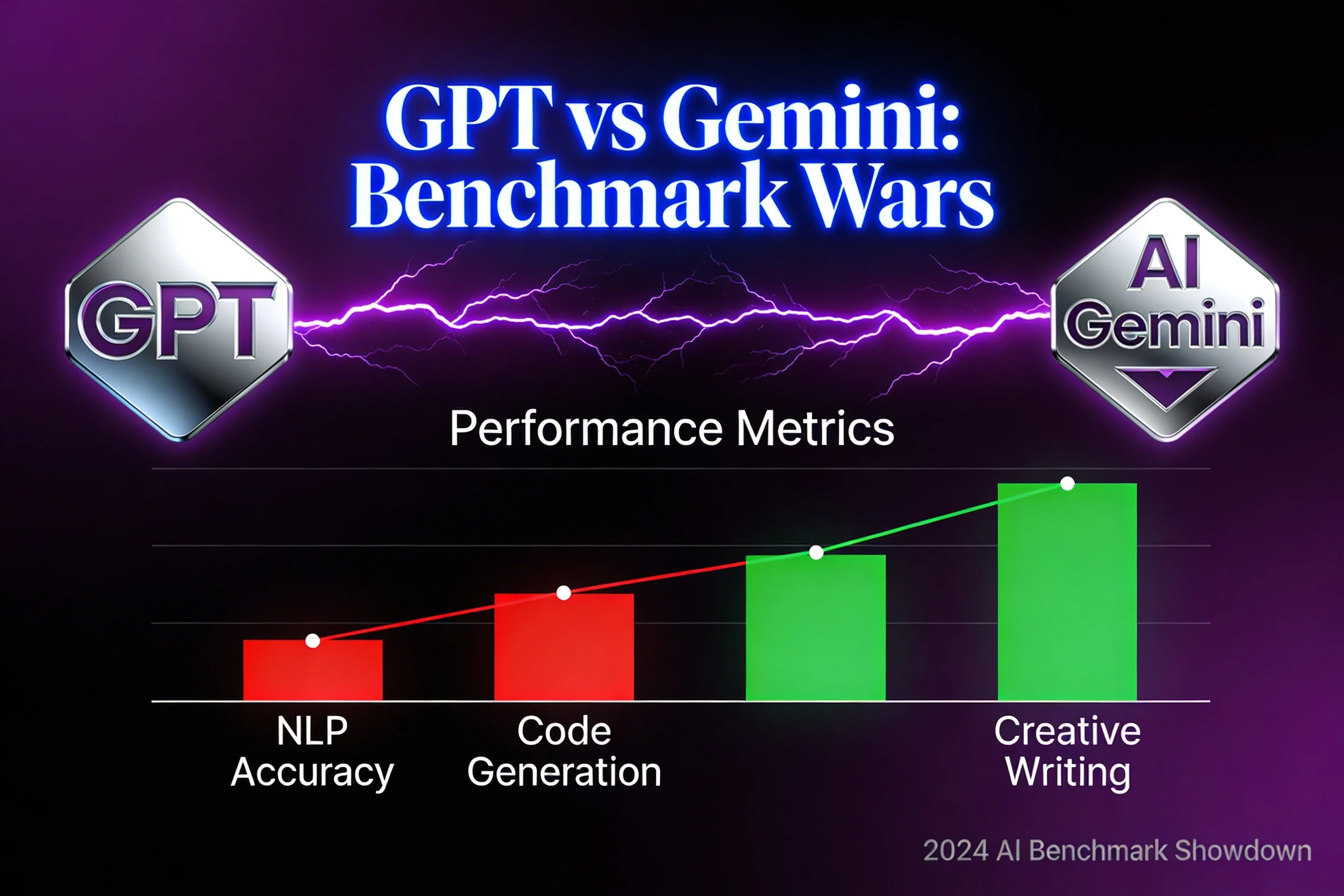
The release cadence between OpenAI and Google has become almost theatrical. GPT-5.2 drops on a Tuesday; by Friday, Google announces Gemini 3 previews for trusted testers. Benchmark scores land on X before the official blog posts are published. By the following Monday, the research community is already poking holes in how each test was administered.
This is the new rhythm of frontier AI development, and if you are building production software on top of these models, it matters more than the headline numbers suggest.
What the Latest Benchmarks Actually Measure
When GPT-5.2 launched, OpenAI led with MMLU-Pro scores and a significant jump on MATH-500. Google countered with Gemini 3's performance on GPQA Diamond (graduate-level scientific reasoning) and a suite of code generation tasks. Both sets of numbers are genuine, and both sets of numbers tell an incomplete story.
The uncomfortable truth about modern AI benchmarks is that they are increasingly teaching to the test. Models are evaluated on datasets that, while not used directly for training, exist within a narrow distribution of problems that frontier labs have been optimizing against for years. When a model scores 92% on a benchmark that was considered superhuman territory eighteen months ago, the question worth asking is whether the benchmark has kept pace with actual capability growth.
Where the Gaps Still Matter
That said, real capability differences between GPT-5.2 and Gemini 3 do exist, and they show up clearly in production workloads:
| Capability | GPT-5.2 | Gemini 3 |
|---|---|---|
| Long-context coherence | Stronger instruction-following at shorter context | Advantage with up to 2M token context window |
| Multimodal reasoning | Tends to hallucinate details in diagrams | Occasionally misses spatial relationships |
| Coding reliability | Edges ahead for Python/TypeScript | Stronger on SQL and data pipeline tasks |
| Reasoning chains | Extended thinking mode supported | Extended thinking mode supported |
- Long-context coherence: Gemini 3's extended context window (reportedly up to 2M tokens in some configurations) gives it a structural advantage for tasks involving large codebases or lengthy document corpora. GPT-5.2 shows stronger instruction-following precision at shorter context lengths.
- Multimodal reasoning: Both models handle image and video input, but their failure modes differ. GPT-5.2 tends to hallucinate details in diagrams; Gemini 3 occasionally misses spatial relationships in complex figures.
- Coding reliability: On internal evals run by engineering teams, GPT-5.2 edges ahead for Python and TypeScript generation with fewer plausible-but-wrong implementations. Gemini 3 performs comparably but shows stronger performance on SQL and data pipeline tasks.
- Reasoning chains: Both support extended thinking modes. The quality of intermediate reasoning steps — not just final answers — has become a key differentiator for agentic applications.
The Benchmark Gaming Problem
Academic benchmarks were designed to measure discrete capabilities under controlled conditions. They were not designed for the scenario we now have: trillion-dollar companies with enormous engineering resources optimizing against them continuously.
Several benchmark contamination studies published in mid-2025 found that frontier models demonstrate statistically anomalous performance improvements specifically on benchmarks that have been publicly available for more than twelve months — improvements that do not generalize to structurally similar but unpublished test sets. This does not prove intentional contamination. It does suggest that the signal-to-noise ratio in public benchmark comparisons has degraded.
The research community's response has been to create dynamic benchmarks — test sets that are regenerated or updated continuously so that memorization cannot explain performance. LiveBench, BenchmarkPlus, and several internal evaluation frameworks at major labs all attempt variations of this approach. None has achieved universal adoption, but the direction is clear.
What Developers Should Actually Do
For teams building with these models, the benchmark wars are mostly noise. What matters is task-specific evaluation on your own workloads:
- Build an eval suite from your production data — anonymized examples of real queries and high-quality reference outputs.
- Test both models at your actual context lengths — a model that leads at 32k context may trail at 200k.
- Measure latency alongside quality — GPT-5.2's extended thinking mode can add 8-15 seconds of wall-clock time on complex tasks, which changes the UX calculus significantly.
- Re-run evals quarterly — model behavior changes with updates, and a winner from three months ago may not be the winner today.
How Multi-Model Access Changes the Equation
One structural consequence of competitive parity between frontier models is that the correct architecture for production AI applications is increasingly multi-model. Rather than betting on a single provider, sophisticated applications route tasks to whichever model performs best for that specific workload.
This is the approach built into Neumar's GenAI Studio. Rather than forcing developers to choose between Claude, GPT-4, Gemini, and capable open-source alternatives, Neumar's chat interface exposes all of them through a unified interface. You can run the same prompt across multiple models and compare outputs directly — a workflow that is genuinely useful when you are trying to understand which model to wire into an automated pipeline.
The multi-model architecture also provides resilience. When OpenAI experiences an API outage (which happens with meaningful frequency at scale), applications built for flexibility can fall back to Gemini or Claude without rewriting any business logic. That reliability characteristic is increasingly part of the value proposition for enterprise buyers.
The Deeper Competition: Not Just Benchmarks
What OpenAI and Google are really competing for is not MMLU points. They are competing for developer mindshare, enterprise contracts, and the infrastructure layer that agentic applications will eventually run on.
GPT-5.2's launch included significant improvements to the Assistants API and the function-calling interface — direct signals that OpenAI is optimizing for developers building agent systems, not just chatbot end-users. Gemini 3 launched alongside expanded Vertex AI integrations, targeting enterprises that have already committed to Google Cloud and want their AI capabilities deeply embedded in existing workflows.
Both companies are also investing heavily in reasoning capabilities that go beyond single-turn Q&A. The models that will define the next competitive cycle are not the ones that score highest on GPQA — they are the ones that can reliably execute multi-step tasks, maintain coherent state across long conversations, and fail gracefully rather than confidently producing wrong answers.
Looking Forward
The benchmark wars will continue because they serve everyone's interests in the short term — they generate press coverage, signal technical ambition, and give enterprise buyers something concrete to point to in procurement decisions. But the meaningful evaluation is happening in production, where developers are learning through direct experience which models do which things well.
For teams building serious AI applications, the most valuable thing the GPT-5.2 vs. Gemini 3 competition produces is not the benchmark scores themselves — it is the rapid pace of capability improvement that competition drives. A year from now, the ceiling on what is possible with inference calls will have shifted substantially again. Building architectures that can absorb those capability improvements without fundamental rewrites is the real engineering challenge.