
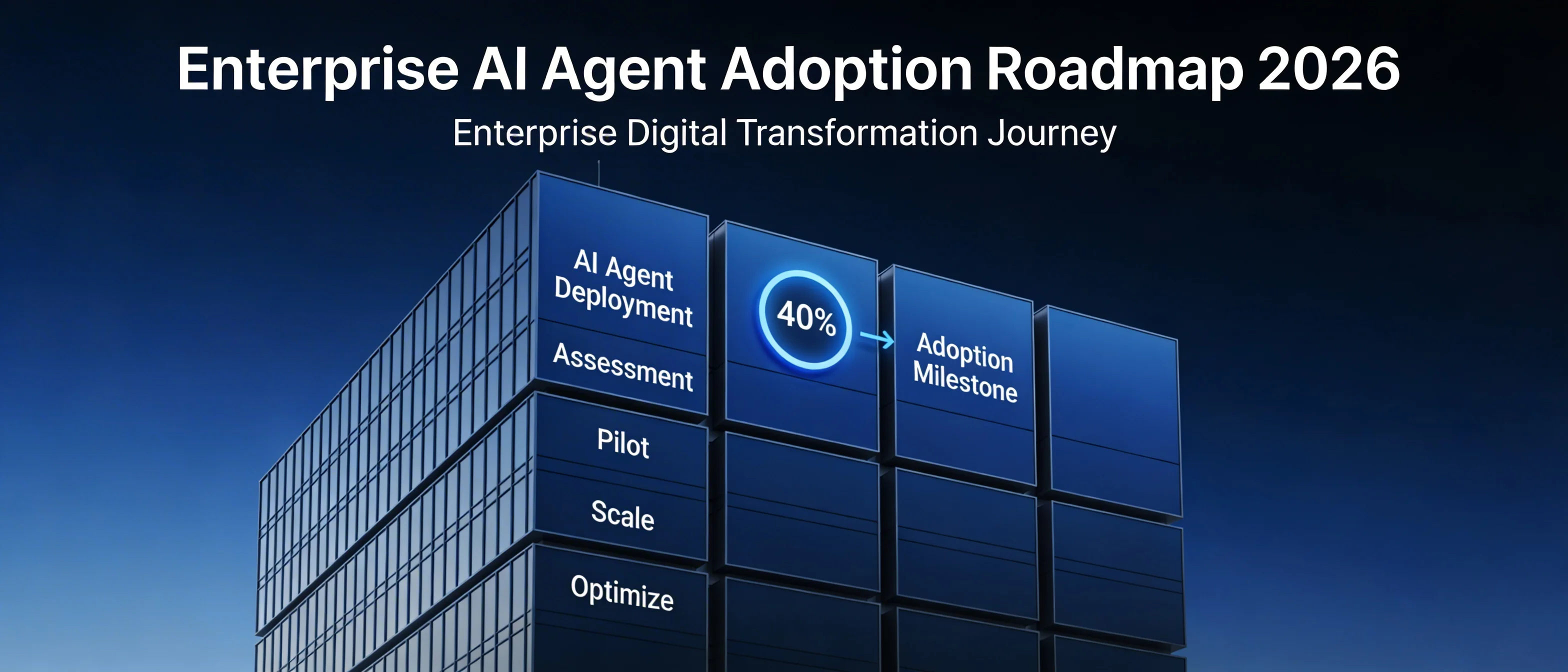
Gartner's prediction that 40% of enterprises will have AI agents in production by 2026 generated the expected range of reactions: enthusiasm from the AI-bullish analyst community, skepticism from enterprise architects who have watched enterprise technology adoption projections overshoot reality for decades, and a complicated silence from the enterprises themselves, many of which are still figuring out what an AI agent actually is in a business context.
The forecast is probably right in direction and probably imprecise in magnitude. Understanding why — and what the adoption trajectory looks like on the ground — is more useful than debating the specific percentage.
Defining the Adoption That Is Actually Happening
The first problem with aggregate enterprise adoption statistics is definitional. "AI agent in production" is doing a lot of work in Gartner's framing. Depending on how you define it, you could argue that enterprises have had "agents" since the first RPA bot was deployed, or you could argue that no enterprise has a true autonomous agent in production yet.
A more useful taxonomy distinguishes three levels of agentic deployment that enterprises are currently at different stages of:
Assisted agents: AI systems that can execute specific, well-defined tasks autonomously but are embedded in human-supervised workflows. A coding assistant that can implement a feature from a specification, subject to human review before merge, is an assisted agent. Most enterprise "AI agent" deployments are at this level. The human is still making the key decisions; the agent is executing the implementation steps.
Orchestrated agents: AI systems that can handle more complex multi-step workflows with periodic human checkpoints. A customer service agent that can resolve the 80% of tickets that follow a known pattern, escalating the remaining 20% to human agents, operates at this level. The agent is making real decisions within a bounded domain; humans review exceptions rather than every transaction.
Autonomous agents: AI systems that operate with minimal human oversight over extended periods and across complex, open-ended tasks. Genuine end-to-end automation of knowledge work processes falls here. Most enterprises are conducting pilots at this level; very few have reached production deployment at scale.
Gartner's 40% figure is almost certainly counting the first category heavily, which is appropriate — assisted agents are where most real business value is being generated today, and they are genuinely agentic in the meaningful sense of being able to plan and execute sequences of actions.
What Is Actually Driving Adoption
Several structural factors are accelerating enterprise AI agent adoption faster than previous enterprise technology waves:
ROI Is Measurable and Rapid
Unlike many enterprise technology investments where ROI is indirect and takes years to materialize, AI agent deployments in well-chosen use cases produce measurable outcomes quickly. A support ticket automation system that routes and resolves 60% of tier-1 tickets without human handling produces directly quantifiable cost savings. A PR review agent that catches a category of bugs that previously reached production creates measurable quality improvement.
The measurability of outcomes creates faster internal buy-in cycles. When an engineering team can demonstrate that an AI agent is handling two hundred routine tasks per week that would otherwise have required manual effort, that story travels quickly within organizations and accelerates expansion to adjacent use cases.
The Infrastructure Is Maturing
Eighteen months ago, deploying an AI agent in production required building most of the supporting infrastructure from scratch: memory management, tool call orchestration, retry logic for model failures, monitoring, and security controls. That infrastructure is now largely available off-the-shelf through managed services, open-source frameworks, and commercial platforms.
The reduction in build cost has a direct effect on adoption because it changes the total investment required to reach production. A use case that would have required a team of six engineers working for three months can now be delivered by a team of two in three weeks. That change in effort profile opens up a much larger range of use cases to the enterprise cost-benefit calculus.
Model Reliability Has Improved
The most persistent concern among enterprise technology leaders considering AI agent deployment has been reliability — not capability, but the probability that the agent behaves correctly on any given task execution. Hallucination, inconsistent instruction-following, and sensitivity to prompt phrasing created real operational risk in early deployments.
Model reliability on structured, well-defined tasks has improved substantially through 2025. Enterprises that ran pilots in 2023 and found error rates too high for production are revisiting those use cases with current models and finding meaningfully different results.
The Friction Points That Slow Adoption
Despite the favorable conditions, several friction points consistently slow enterprise AI agent adoption:
Security and Compliance Review Cycles
Enterprise security teams have legitimate concerns about AI agents with access to internal systems, data, and APIs. An agent that can read email, query databases, and execute code has a large attack surface. An agent that operates autonomously without creating a comprehensible audit trail creates compliance exposure.
These concerns do not make agent deployment impossible, but they add significant time and process overhead to the path from pilot to production. Security review cycles that take three to six months are not uncommon for agent deployments with significant system access.
The enterprises that are moving fastest on agent deployment are those that have invested in this review process proactively — establishing security frameworks for agent deployments before specific use cases arrive, rather than improvising each time.
Integration Complexity
The promise of AI agents is that they can work across systems, combining data from multiple sources and taking actions in multiple places. The reality is that integration complexity multiplies with each system the agent needs to access. Legacy enterprise systems — the ERP systems, the HR platforms, the internal tools built five years ago — often lack clean APIs, have inconsistent data models, and require custom integration work that is time-consuming and brittle.
MCP is beginning to address this for developer-facing tools, but enterprise system integration remains largely manual for most organizations. This friction is real and will not be eliminated quickly.
Organizational Resistance
The hardest adoption challenges are not technical. In many enterprises, the processes that AI agents would automate are the professional domain of specific teams or individuals. Proposing to automate those processes requires navigating organizational politics, managing change management for affected employees, and addressing concerns about role displacement.
Teams that frame agent deployment as augmentation — giving people leverage to do more meaningful work by handling routine tasks — generally move faster than teams that frame it as headcount reduction. The framing is not just communication strategy; it reflects a genuine difference in deployment approach.
What the Leading Adopters Are Doing Differently
Enterprises that are ahead of the adoption curve share several characteristics:
They start with the highest-volume, lowest-stakes tasks. The initial agent deployments that generate credibility within an organization are typically tasks where the stakes of an individual error are low but the volume is high. Code documentation generation, internal FAQ answering, data formatting and transformation — these are good first deployments because the aggregate value is real, the error cost is low, and they generate the organizational confidence to tackle harder problems.
They instrument everything from day one. Teams that track agent behavior, error rates, escalation patterns, and cost per task from initial deployment are able to improve their agents quickly and demonstrate improving ROI over time. Teams that skip instrumentation spend months debugging production issues they cannot characterize.
They treat agent prompts as production code. The engineering discipline around prompt management — version control, testing, staged rollouts, rollback capability — is often absent in early agent deployments and becomes an urgent problem when a prompt change causes unexpected behavior at scale.
They plan for the human handoff. Agents deployed without a clear human escalation path for edge cases tend to fail in ways that create significant cleanup work. The most reliable production deployments have clear routing for tasks the agent cannot handle confidently, with explicit criteria for what triggers escalation.
Where Neumar Fits in the Enterprise Picture
For engineering teams navigating the enterprise adoption path, Neumar addresses the friction at the developer workflow layer rather than the business process layer. The use case is not replacing a business process with an autonomous agent; it is giving individual developers the agent capabilities that let them move faster within their existing process.
The Linear ticket-to-PR pipeline is a good example: rather than automating away the engineering team's work, it compresses the tedious parts of that work — reading requirements, setting up branch scaffolding, writing boilerplate implementation, creating test cases — so that developers spend their time on the decisions that actually require judgment.
This developer-productivity entry point often turns out to be the fastest path into an organization's broader agent adoption journey, because it generates tangible results for the people who will eventually be advocating for wider deployment.
Enterprise Agent Deployment Levels
| Level | Description | Human Role | Adoption Status (2026) |
|---|---|---|---|
| Assisted Agents | Execute well-defined tasks within human-supervised workflows | Reviews every output before use | Most enterprise deployments |
| Orchestrated Agents | Handle multi-step workflows with periodic human checkpoints | Reviews exceptions (~20%) | Growing pilots and early production |
| Autonomous Agents | Operate with minimal oversight over extended, open-ended tasks | Periodic strategic review | Mostly pilot stage |
Key Adoption Drivers vs. Friction Points
| Drivers | Friction Points |
|---|---|
| Measurable, rapid ROI on well-chosen use cases | Security and compliance review cycles (3-6 months) |
| Maturing infrastructure (managed services, OSS frameworks) | Integration complexity with legacy enterprise systems |
| Improved model reliability on structured tasks | Organizational resistance and change management |
| Reduced build cost (2 engineers / 3 weeks vs. 6 / 3 months) | Vendor lock-in concerns across cloud providers |