
One of the persistent objections to deploying AI agents in enterprise environments is the question of confidence before commitment. Agents that can read files, write code, call APIs, and modify databases can also introduce errors, delete the wrong data, or trigger workflows with significant downstream effects. The traditional answer to this concern has been human approval gates — require a person to review and authorize each consequential action.
Human approval gates work. They also negate a large fraction of the productivity benefit agents provide. If every database modification or API call requires a manual sign-off, you have not automated the work — you have automated the proposal of work.
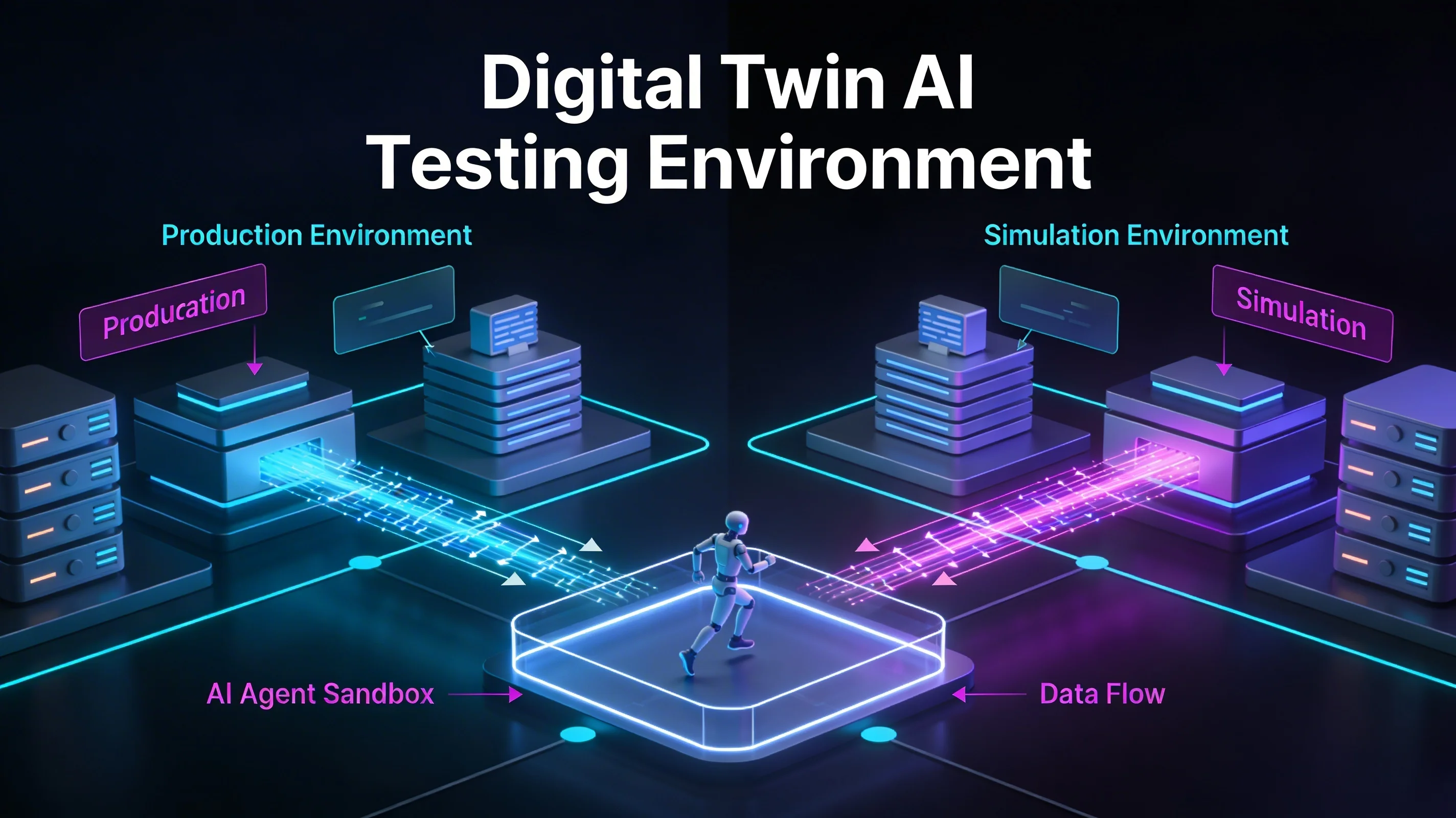
A more promising approach, gaining significant traction in enterprise deployments, is the use of digital twin environments as agent sandboxes: running agent interventions against faithful simulations of production systems before authorizing live execution.
What a Digital Twin Sandbox Provides
A digital twin, in the context of agent deployment, is a continuously synchronized replica of a production environment that accepts agent operations and reports their effects without those effects propagating to production systems.
The key word is continuously synchronized. A static test environment diverges from production over time — schemas change, data ages, integrations shift. An agent that performs correctly against a stale test environment may behave unexpectedly against live production data. Digital twins that maintain tight synchronization with production provide a much stronger test guarantee.
Research published in the Journal of Autonomous Systems in mid-2025 analyzed agent deployment outcomes across 47 enterprise implementations that had adopted digital twin testing versus a control group using traditional testing approaches. The finding that attracted significant attention: teams using continuously synchronized digital twins reported 38% lower deployment uncertainty — measured as the variance in predicted-vs-actual task outcomes — compared to control groups.
Crucially, the paper found that the uncertainty reduction was largest for tasks involving cross-system dependencies: operations that touch multiple systems in sequence, where the state of system B is partially determined by actions taken on system A. These are precisely the task categories where AI agents provide the most value and where errors are hardest to anticipate.
The Architecture of an Agent Sandbox
A well-designed agent sandbox has four components:
1. Synchronized State Mirror
The mirror maintains a consistent copy of the systems the agent will interact with: database state, file system contents, API mock endpoints, and service configurations. The synchronization strategy depends on the system — some can be mirrored with change-data-capture streams, others require periodic snapshots.
The key property is that the mirror is read-only from production's perspective. Agent writes go to the mirror; they never touch production until explicitly authorized.
2. Intervention Executor
The executor runs the agent's planned actions against the mirrored environment, capturing:
- The full sequence of tool calls made
- The intermediate state after each action
- Any errors or unexpected branches
- The final state delta relative to the initial mirror state
This execution log becomes the primary artifact for pre-deployment review.
3. Diff Reporter
The diff reporter translates the state delta into a human-readable summary of what changed and what would change in production if the intervention were applied. For a code change, this is similar to a diff view. For a database modification, it might be a summary of rows affected, schema changes, and referential integrity impacts.
The diff should be structured to highlight irreversible changes — deletions, external API calls with side effects, messages sent — with higher visual prominence than reversible ones.
4. Authorization Gate
The gate presents the diff report to an authorized reviewer and accepts or rejects the production execution. On approval, the agent re-executes against the live environment. The re-execution is not replaying a recorded log — it is running the agent fresh, with the expectation that live execution should closely match sandbox execution.
This last point matters: re-execution against a live environment can diverge from sandbox execution if production state has changed since the mirror was synchronized. Good sandbox systems include staleness checks and require re-synchronization if the mirror is older than a configurable threshold.
Workspace Isolation as the Foundation
A sandbox architecture depends on a foundational property: the agent's filesystem and network operations must be strictly confined to the sandboxed environment. An agent that can bypass the sandbox and write directly to production — through an unconstrained filesystem path, an unauthenticated API endpoint, or a misconfigured network route — provides no safety guarantee regardless of how sophisticated the diff reporting is.
Neumar's workspace isolation model enforces this at the architecture level. All agent file operations are confined to the user-configured workspace directory. The workspace boundary is not a soft convention — it is enforced by the Tauri filesystem plugin's scope configuration and validated on every operation. An agent cannot write outside its workspace any more than a browser extension can access files outside its permitted scope.
This property is the prerequisite for everything else in the sandbox architecture. Without it, the diff report is advisory at best; the agent could already have made changes that the report does not reflect.
Practical Tradeoffs
When Digital Twin Sandboxes Are Worth the Investment
The setup cost of maintaining a continuously synchronized digital twin is non-trivial. It requires infrastructure for mirror synchronization, tools for capturing and diffing state changes, and an authorization workflow. For most small teams and personal-use agent applications, this overhead is not justified.
The calculus changes for:
- High-consequence environments: database migrations, production deployments, financial data processing
- Cross-system workflows: tasks that touch multiple integrated systems where partial execution creates inconsistent state
- Regulated industries: healthcare, finance, and legal contexts where audit trails and pre-authorization are compliance requirements
In these contexts, the 38% reduction in deployment uncertainty translates directly to reduced incident rates, faster incident recovery (because the pre-execution log provides a clear rollback guide), and faster approval cycles (because reviewers are evaluating a precise diff rather than interpreting a natural language description of what the agent plans to do).
The Limitation of Static Simulation
No digital twin perfectly models every aspect of a production environment. Rate limits behave differently under simulated load. Third-party API behaviors are approximated by mocks. Timing-dependent state transitions may not replicate faithfully.
The 38% uncertainty reduction figure implies that significant uncertainty remains. Digital twin sandboxes reduce the risk of agent deployment; they do not eliminate it. The appropriate mental model is not "we tested it in the sandbox, therefore it's safe" but rather "we have a much more informed basis for the authorization decision than we would have without the sandbox."
Connection to Agent Governance
The digital twin sandbox pattern is one component of a broader agent governance architecture. It handles the "what will this agent do?" question by making the intervention's effects observable before authorization. But governance also requires answering "should this agent be authorized to do this at all?" and "who is accountable when this agent's actions cause harm?"
Upcoming posts will explore these questions through the lens of autonomy certificates and behavioral credentialing — a governance framework that complements sandboxing by establishing what categories of action an agent is certified to perform without human review.
For now, the digital twin research represents a practically deployable answer to one of the most common blockers to enterprise agent adoption. The tools for building synchronized mirrors and diff reporters are available today, and the 38% uncertainty reduction is achievable without waiting for the governance frameworks to mature.
Agent Sandbox Architecture Components
| Component | Function | Key Property |
|---|---|---|
| Synchronized State Mirror | Maintains consistent copy of production systems | Read-only from production's perspective |
| Intervention Executor | Runs agent actions against mirrored environment | Captures full sequence, intermediate states, errors |
| Diff Reporter | Translates state delta to human-readable summary | Highlights irreversible changes with higher prominence |
| Authorization Gate | Presents diff for review; accepts or rejects live execution | Includes staleness checks for mirror freshness |
When Digital Twin Sandboxes Are Worth the Investment
| Use Case | Why It Matters | Benefit |
|---|---|---|
| High-consequence environments | Database migrations, production deploys, financial processing | 38% lower deployment uncertainty vs. traditional testing |
| Cross-system workflows | Tasks touching multiple integrated systems | Prevents inconsistent state from partial execution |
| Regulated industries | Healthcare, finance, legal | Audit trails and pre-authorization for compliance |