
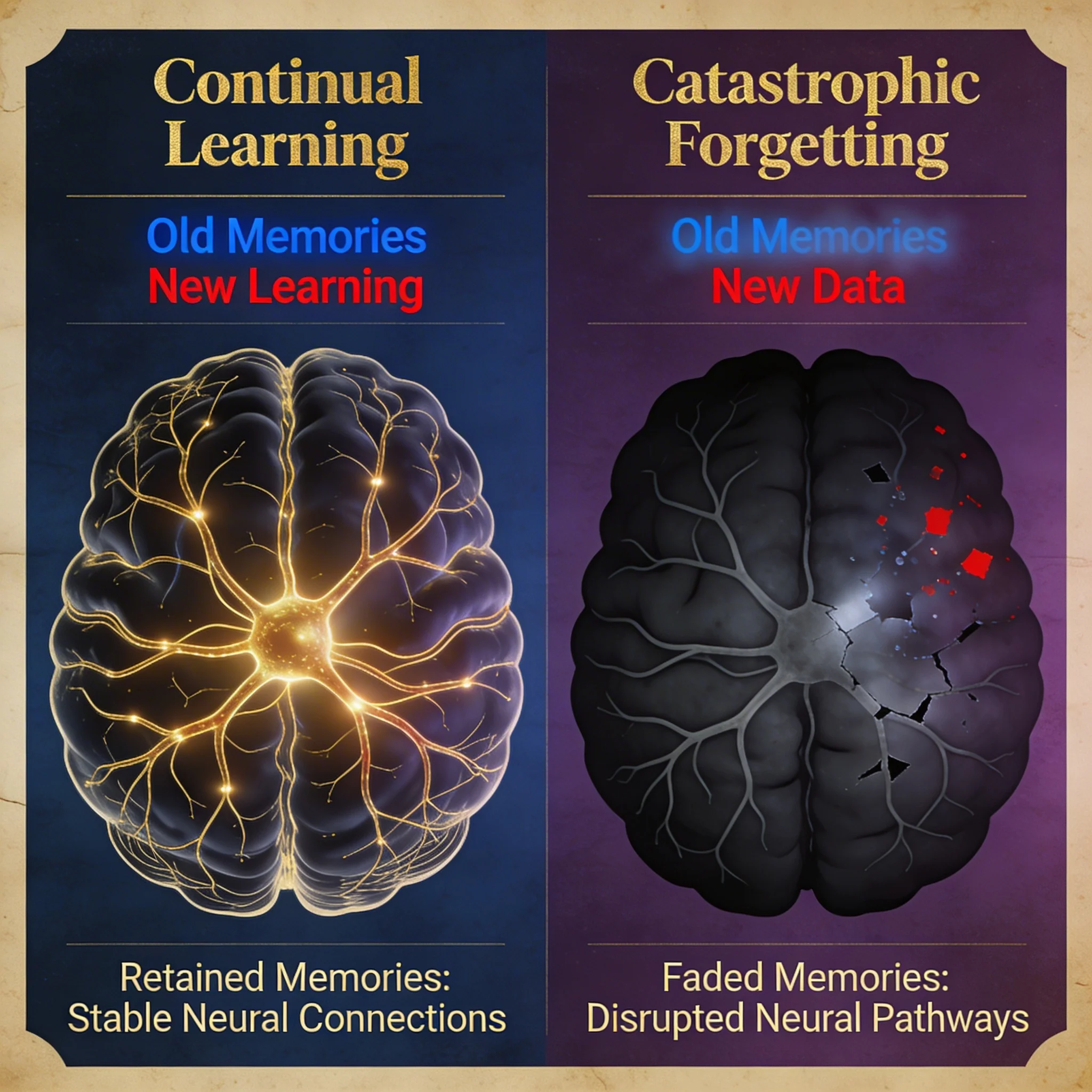
Every interaction you have with an AI agent that lacks persistent memory starts from zero. Previous conversations, established preferences, project context, past mistakes — all gone. You are not working with an intelligent collaborator that grows more useful over time. You are working with a very capable stateless function.
This is not a minor inconvenience. It is a fundamental constraint on what class of problems an agent can usefully address. Tasks that benefit most from AI assistance — complex software projects, ongoing research, iterative writing, project management — are exactly the tasks that require accumulated context over weeks and months.
The research question behind this problem is called continual learning, and the challenge standing in its way is catastrophic forgetting.
The Catastrophic Forgetting Problem
Catastrophic forgetting is a well-documented phenomenon in neural networks: when a model is trained on new data, it overwrites the weights that encoded previous knowledge. The result is that performance on earlier tasks degrades, sometimes dramatically, as new information is incorporated.
The term was coined in the early 1990s by McCloskey and Cohen, but it became a central concern for deep learning researchers around 2015-2016 as the field began exploring continual or "lifelong" learning scenarios. The problem is more severe for deep neural networks than for shallower architectures because of how distributed the representation of knowledge is across the weight matrix.
For large language models deployed as agents, the problem manifests differently than it does for research models being continually fine-tuned. Most deployed LLMs have frozen weights — they are not being retrained between user sessions. The "forgetting" problem for these systems is not weight overwriting; it is the absence of any mechanism to carry forward what was learned during one session into the next.
This is a different kind of forgetting, but the functional consequence is the same: the agent cannot build on experience.
Research Approaches to Continual Learning
Three broad research directions have emerged for addressing catastrophic forgetting in machine learning systems:
Regularization-Based Methods
Elastic Weight Consolidation (EWC) and similar approaches add regularization terms to the training objective that penalize changes to weights that are important for previously learned tasks. The intuition is to identify "important" weights — those that encode knowledge the system should retain — and protect them from large updates when learning new tasks.
These methods work well in controlled benchmarks but face scalability challenges. Identifying which weights encode which knowledge becomes increasingly expensive as the model grows, and the trade-off between plasticity and stability is difficult to calibrate across heterogeneous task types.
Memory Replay
Memory replay methods maintain a buffer of exemplars from previous tasks and interleave them with new training data. This prevents the distribution shift that drives catastrophic forgetting — the model sees reminders of what it previously knew alongside new information.
The challenge is storage and selection: which exemplars to keep, how many to retain, and how to ensure the replay distribution reflects the original task distribution adequately.
External Memory Systems
The most practically relevant approach for deployed LLM-based agents is external memory: storing information outside the model's weights in a retrievable format, and giving the model access to that store via tool calls or retrieval mechanisms.
This approach sidesteps the weight-level catastrophic forgetting problem entirely. The model's weights do not need to change — instead, experience accumulates in an external store that the model can query. The challenge shifts from preserving weight knowledge to designing effective storage, retrieval, and synthesis mechanisms.
How External Memory Works in Practice
A well-designed external memory system for agents typically has three layers:
Working Memory
Working memory holds the current session context — the conversation history, active task state, and recently accessed documents. For LLM-based agents, this maps directly to the context window. Working memory is fast and highly available, but limited in size and ephemeral by default.
Episodic Memory
Episodic memory stores records of past interactions, organized around episodes: coherent chunks of agent activity with associated outcomes. An episode might be a completed task, a resolved debugging session, or a research synthesis.
Episodic records are typically stored with dense vector embeddings generated from a sentence embedding model. Retrieval is similarity-based: given the current task context, find the N most semantically similar past episodes. This lets the agent surface relevant prior experience without requiring exact keyword matches.
Semantic Memory
Semantic memory stores extracted facts, preferences, and generalizations — distilled knowledge that should persist across many episodes. If a user consistently prefers a particular code style, that preference is a semantic memory entry. If an agent discovers that a particular API has a non-obvious authentication requirement, that is a candidate for semantic memory.
Semantic memory entries are shorter and more structured than episodic records. They are typically indexed by topic or entity for retrieval, and they are subject to update and conflict resolution when new experience contradicts existing entries.
Neumar's Long-Term Memory Architecture
Neumar's memory system implements this layered model. Working memory is the active context window for the current conversation. Between sessions, the system maintains episodic and semantic stores that persist across agent restarts.
When a new task begins, the memory system performs retrieval: searching both the episodic store (what past tasks are similar to this one?) and the semantic store (what persistent facts are relevant to this task?). Retrieved memories are injected into the agent's context as part of the system prompt, giving the agent access to accumulated experience without requiring any change to the underlying model.
This architecture means that Neumar agents genuinely improve as you use them — not because the model weights change, but because the accessible store of relevant prior experience grows. An agent that has helped you debug your codebase a dozen times has richer episodic memory of your project's patterns, your debugging preferences, and the recurring issues in your specific stack.
The Embedding Layer
The quality of memory retrieval depends heavily on the embedding model used to index episodic records. Poor embeddings produce retrieval results that are lexically similar but semantically irrelevant — or miss highly relevant past experiences because they were phrased differently.
Modern sentence embedding models (the text-embedding-3-large family and similar) produce embeddings that capture semantic similarity much more reliably than older bag-of-words approaches. The practical impact on memory-augmented agents is substantial: relevant past experience surfaces more consistently, and irrelevant noise is filtered more effectively.
The Open Problems
External memory architectures solve the immediate forgetting problem for deployed agents, but they introduce new challenges that the research community is actively working on.
Memory coherence: As the episodic store grows, contradictions accumulate. An agent that learned your preferred authentication pattern six months ago may have stored an outdated entry that conflicts with your current preferences. Detecting and resolving these contradictions without manual curation is an open problem.
Memory relevance decay: Old memories are not always less relevant than recent ones, but recency bias in retrieval is a real failure mode. A pattern established over many sessions two years ago may be more representative of stable preferences than a single session last week.
Privacy and selective forgetting: Users may want to delete specific memories — past mistakes, sensitive project details, outdated preferences. Memory systems that treat the store as append-only make this difficult. Production systems need explicit deletion and expiration mechanisms.
Cross-context generalization: Extracting genuinely generalizable knowledge from episodic records — as opposed to surface-level pattern matching — remains the hardest open problem. The gap between "retrieved a similar past episode" and "understood the lesson from that episode" is still largely bridged by the base model's reasoning capability, not the memory system itself.
Despite these open problems, the practical value of even basic external memory architectures is substantial. The alternative — stateless agents that restart from zero every session — has a hard ceiling on usefulness for any task that rewards accumulated context. The research direction is clear; the implementation details are where the current work is happening.
Continual Learning Research Approaches
| Approach | Mechanism | Strengths | Limitations |
|---|---|---|---|
| Regularization (EWC) | Penalizes changes to important weights | Preserves prior task knowledge during training | Scalability issues; plasticity-stability trade-off hard to calibrate |
| Memory Replay | Interleaves stored exemplars from past tasks with new data | Prevents distribution shift | Storage and exemplar selection challenges |
| External Memory | Stores experience outside model weights; retrieves via tool calls | No weight changes needed; scales independently | Retrieval quality depends on embeddings; coherence and decay issues |
Agent Memory Architecture Layers
| Layer | Contents | Persistence | Retrieval Method |
|---|---|---|---|
| Working Memory | Current session context, conversation history, active task state | Ephemeral (session-scoped) | Direct context window access |
| Episodic Memory | Records of past interactions organized as coherent episodes | Persistent across sessions | Similarity-based (dense vector embeddings) |
| Semantic Memory | Extracted facts, preferences, generalizations | Persistent, subject to updates | Topic/entity index lookup |
References
- McCloskey and Cohen, "Catastrophic Interference in Connectionist Networks" (1989)
- Kirkpatrick et al., "Overcoming catastrophic forgetting in neural networks" (Elastic Weight Consolidation, 2017)
- OpenAI text-embedding-3-large model documentation
- MemGPT: Towards LLMs as Operating Systems (Packer et al., 2023)