
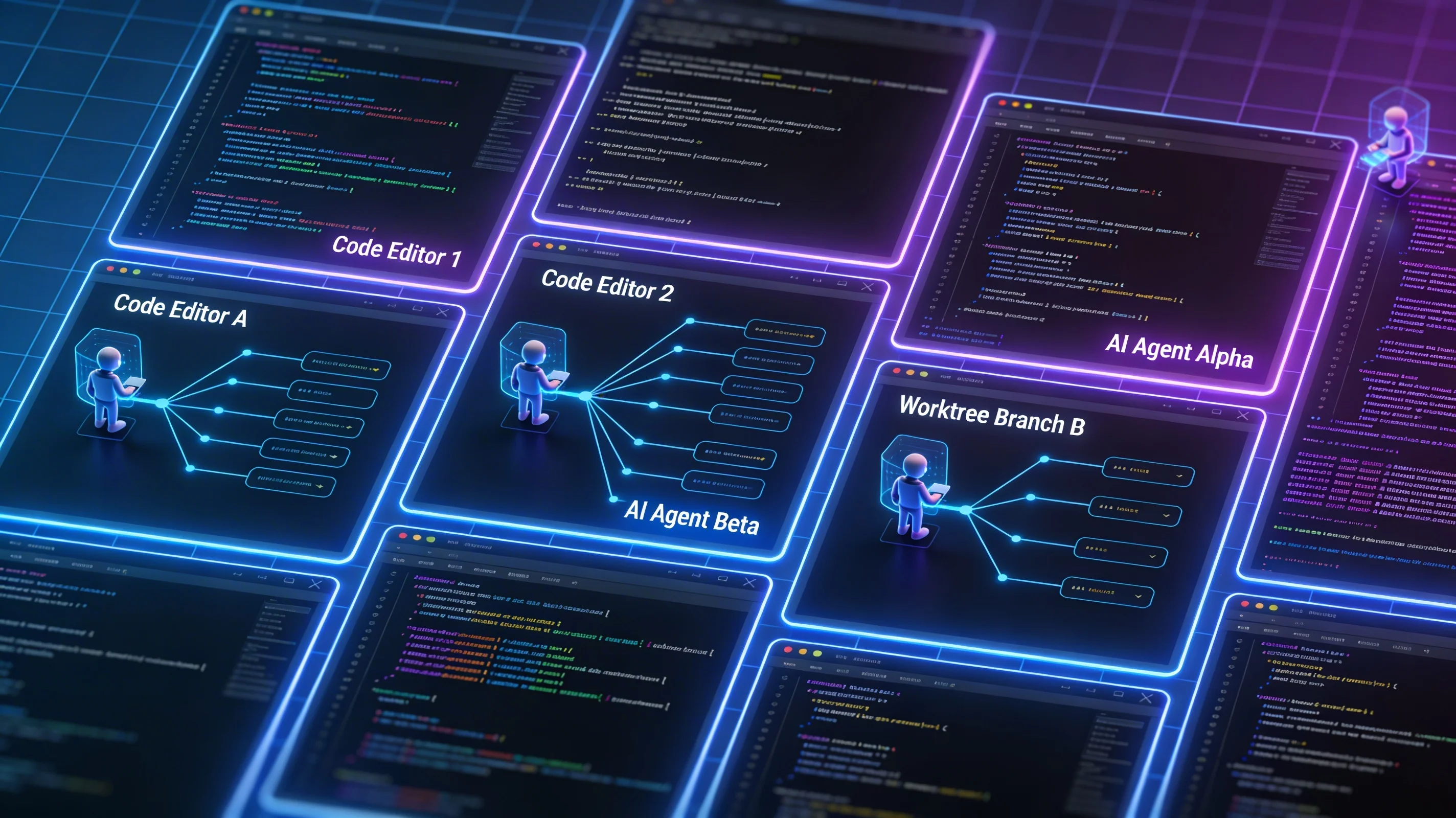
The first generation of AI coding tools competed on completion quality: which assistant's inline suggestions were most accurate, which chat interface produced the cleanest code for a given prompt. That competition is largely over. The frontier tools are all competent at individual completions, and the differentiation has shifted to a more interesting set of capabilities: how do AI tools handle parallel work, multi-agent coordination, and long-horizon tasks that span multiple sessions?
The emerging features reshaping professional development workflows in early 2026 — arena mode, parallel worktrees, background agents, and multi-agent task distribution — represent a qualitatively different kind of capability. This is not better autocomplete. This is a different model of how software gets made.
Arena Mode: Running Models in Parallel
Arena mode (the term comes from Cursor, though variations appear in other tools) is the ability to send the same task to multiple AI models simultaneously and review their outputs side by side. The name comes from the LMSYS Chatbot Arena benchmarking methodology, where models compete head-to-head on the same prompts.
For coding tasks, arena mode is more nuanced than a simple competition. Different models have different strengths: one may produce more idiomatic code for a given language, another may handle edge cases more carefully, a third may write better inline documentation. Running all three on the same task and selecting the best elements from each — or synthesizing them into a single implementation — produces results that consistently exceed what any single model would have generated.
The practical workflow: you describe a feature or refactoring task, the IDE sends it to two or three models concurrently, and you review the implementations in parallel panes before committing any changes. This adds thirty to sixty seconds to the task compared to accepting a single model's output — and for non-trivial implementations, it reliably produces better results.
Arena mode also functions as ongoing capability evaluation. Developers who use it consistently develop an empirical sense of which models perform well on which task types in their specific codebase. That knowledge compounds: over time, you route tasks to the model that handles them best rather than defaulting to a single provider.
Neumar's GenAI Studio implements a similar principle for multi-model comparison. Users can submit the same prompt to Claude, GPT-4, Gemini, and open-source models via OpenRouter in a single interface and compare outputs directly. For developers building on top of AI APIs, this is also a practical tool for model selection: you can evaluate which model produces the desired output format and quality level before committing to a provider for a given use case.
Parallel Worktrees: Concurrent Implementation Paths
Git worktrees allow a repository to have multiple working trees checked out simultaneously, each in a separate directory. This feature has existed for years but was rarely used because managing parallel development manually is expensive. AI agents change that calculus.
The parallel worktree pattern for AI-assisted development: you have a task that could be implemented several ways. Rather than picking one approach speculatively, you spawn multiple agents on different worktrees, each implementing a different approach, and evaluate the results before merging any of them.
Concretely: "implement the new caching layer" might spawn three agents on three separate worktrees — one using Redis with a write-through strategy, one using an in-memory LRU cache, one using the existing database with a materialized view. Each agent produces a complete implementation with tests. You review all three, pick the best approach, and discard the others. The cost of exploring multiple implementation strategies becomes a parallelism cost rather than a sequential time cost.
For teams working on architecturally significant decisions, this is genuinely valuable. The traditional approach is to spike each option sequentially — spending a day on each to understand its implications before choosing. With parallel worktrees and capable agents, you can run all three spikes simultaneously and complete the evaluation in the time it would previously have taken for a single spike.
The practical limitation is review burden. Three complete implementations is also three implementations to read, understand, and compare. Arena mode makes this easier by providing side-by-side comparison, but the developer still needs to make a genuine architectural judgment. The quality of that judgment depends on the developer's ability to evaluate AI-generated code critically — which is, itself, becoming a more important skill than writing it.
Background Agents: Asynchronous Task Execution
Background agents — tasks that continue running while the developer works on something else — are appearing across multiple tools in 2026. The concept is simple: assign a bounded task to an agent, continue with other work, and receive a notification when the agent is done with a diff ready for review.
This is the AI equivalent of asynchronous code. Just as non-blocking I/O dramatically increases throughput by allowing computation to proceed while waiting for slow operations, background agents allow development work to proceed while AI handles bounded tasks that do not require the developer's continuous attention.
The tasks that work well for background agents are those with clear inputs, clear success criteria, and relatively contained scope: writing tests for an existing function, updating documentation to match recent changes, migrating a specific module to a new API, or investigating a specific class of bug. Tasks with ambiguous success criteria or that require significant human judgment mid-task are better handled interactively.
Background agents require two things to be useful in practice: reliable task scoping (the agent needs to know where its task ends and not drift into adjacent work) and trustworthy output quality (a background agent that produces output requiring significant rework provides less value than expected). The tools that get this right are those with strong task scoping primitives and high enough output quality that the review-and-merge step is faster than doing the task manually.
Multi-Agent Orchestration in Development Workflows
The most sophisticated capability emerging in agentic IDEs is multi-agent orchestration: coordinating multiple specialized agents to execute a development workflow that exceeds what any single agent can handle alone.
The Linear-to-PR pipeline is a concrete example. A developer marks a ticket as ready for development. An orchestrator agent reads the ticket, queries the codebase for relevant context, breaks the work into implementation subtasks, spawns specialized agents for each subtask (one for backend changes, one for frontend changes, one for tests, one for documentation), coordinates their outputs, resolves conflicts between them, and opens a PR with the complete implementation. The developer reviews a complete PR rather than supervising each step.
This is not hypothetical in 2026 — it is available in Neumar's agent runtime and in early-access features of several IDE tools. The implementation quality varies considerably, and the tasks that succeed reliably are bounded ones with clear scope. Open-ended feature development with significant architectural implications still requires human steering throughout.
The development skills this rewards are different from those valued in the pre-AI era. The ability to write precise, well-scoped task specifications that agents can execute without drift has become genuinely important. Reviewing AI-generated code critically and quickly — understanding what was done, why, and whether it is correct — matters more than ever. And the judgment to know which tasks are suitable for autonomous execution and which require human reasoning throughout is increasingly the differentiator between developers who get productivity gains from AI tooling and those who get disappointed by it.
Neumar's Multi-Agent Capabilities
Neumar's agent runtime supports multi-agent task distribution through its Claude Agent SDK integration. The two-phase plan-then-execute architecture provides natural task decomposition: the planning phase identifies subtasks, and the execution phase can route different subtasks to different agent configurations with different tool access and context.
For the Linear-to-PR pipeline specifically, Neumar's native Linear integration reads ticket context and project history, constructs a task specification, executes the implementation through the agent runtime, runs validation (type checking, tests, linting), and creates the PR through the GitHub MCP integration. Each phase uses the agent capabilities appropriate to it.
The long-term memory system provides the context that makes multi-agent coordination coherent over time. An orchestrator that understands the project's conventions, recent architectural decisions, and the specific characteristics of the codebase coordinates subtask agents more effectively than one operating from a cold start. The accumulated context is the compounding advantage that separates a single impressive demo from reliable, sustained productivity.
What These Features Mean for Development Teams
The agentic IDE features maturing in 2026 are not incremental improvements to a familiar tool category. They represent a structural shift in how software development work gets organized.
The shift is from "developer writes code, AI suggests improvements" to "developer defines intent, multiple agents execute in parallel, developer reviews and synthesizes outcomes." This is a different division of labor, with different skill requirements, different quality bottlenecks, and different leverage points.
Teams that adapt their workflows to this new model — investing in task specification skills, review capacity, and the tooling to coordinate parallel agent work — will see compounding productivity gains. Teams that use agentic features as smarter autocomplete will see incremental gains but miss the more significant shift. The tools are ready. The question is whether the development practices are.
Agentic IDE Feature Comparison
| Feature | How It Works | Best For | Key Limitation |
|---|---|---|---|
| Arena Mode | Same task sent to multiple models; outputs compared side by side | Non-trivial implementations where quality matters | Adds 30-60 seconds for parallel model runs |
| Parallel Worktrees | Multiple agents implement different approaches on separate git worktrees | Architecturally significant decisions with multiple viable strategies | Review burden multiplies with each worktree |
| Background Agents | Bounded tasks execute asynchronously; developer notified on completion | Clear-scope tasks (tests, docs, migrations) | Requires reliable task scoping and high output quality |
| Multi-Agent Orchestration | Orchestrator decomposes work across specialized agents | End-to-end workflows (ticket to PR) | Open-ended tasks still need human steering |