
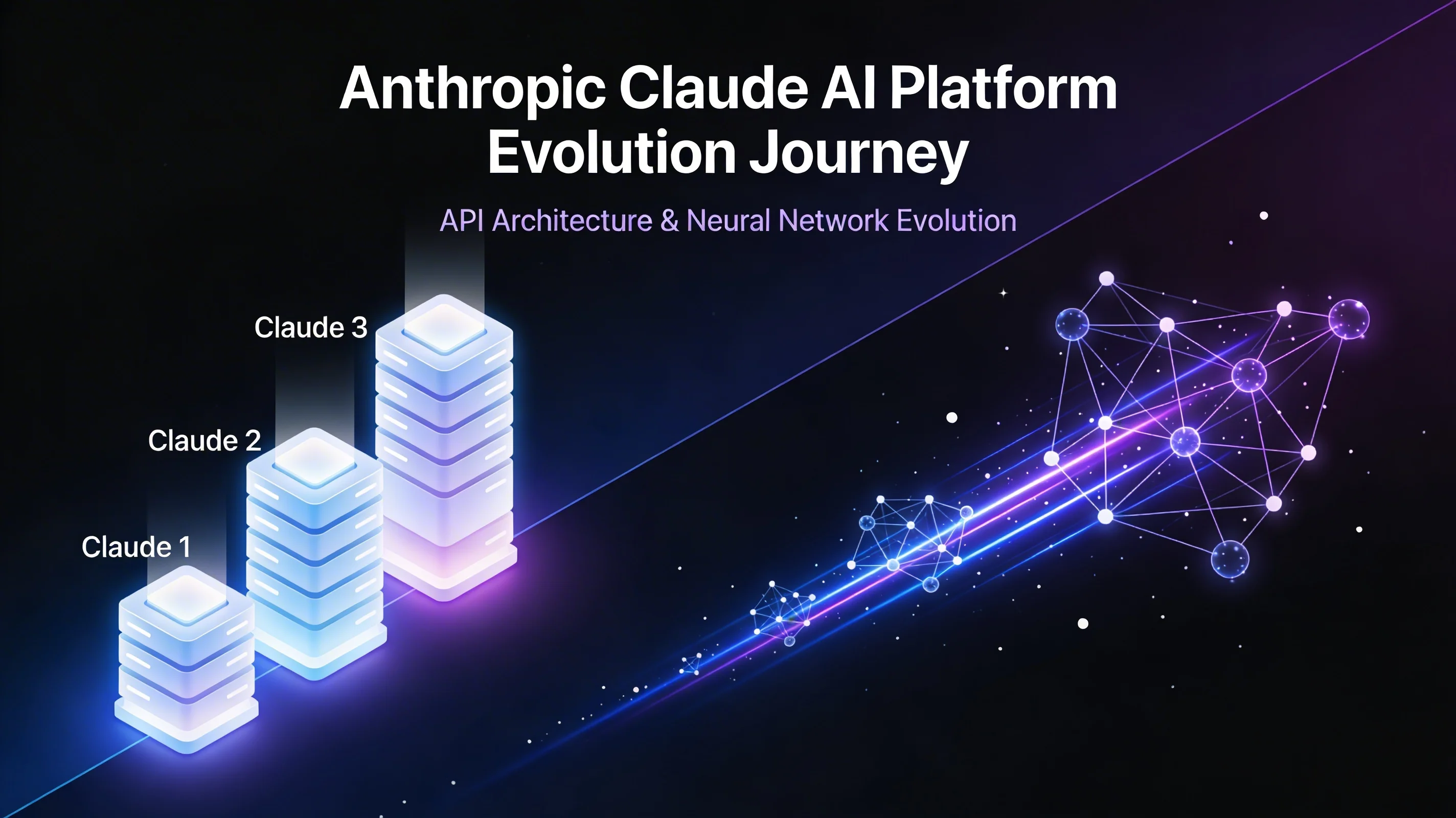
Anthropic's trajectory from a research-focused AI safety lab to a company shipping a production-grade agent development platform has been faster and more consequential than most outside observers expected in 2022. The Claude Agent SDK, which underpins Neumar's agent orchestration layer, did not emerge fully formed — it is the product of a specific sequence of product and research decisions that are worth understanding if you are building on top of Anthropic's platform.
The Early Claude API: Powerful but Unstructured
The original Claude API, available through Anthropic's initial commercial release in March 2023, offered a powerful language model through a familiar text completion interface. Developers could send prompts and receive completions. The model's constitutional AI training produced notably better calibration on refusals and a more collaborative tone than competing models at the time.
What the early API lacked was structure for agent use cases. Tool use — the ability for the model to request structured calls to external functions and receive structured results — was not supported in the initial release. Developers who wanted agent-like behavior implemented it through creative prompt engineering: defining available actions in system prompts, parsing model outputs to extract action calls, and injecting results back into the conversation as human-turn messages.
This worked, but it was fragile. Parsing model outputs for structured action calls introduced brittleness whenever the model deviated from the expected output format. There was no standard error handling for failed tool calls, no native support for multi-turn tool use sequences, and no first-class mechanism for the model to signal that it was done versus that it needed another tool call.
Tool Use and the First Real Agent API (2023-2024)
Anthropic introduced native tool use support in 2023, and the impact on agent development was substantial. Rather than parsing action calls from model text output, developers could define tools as typed schemas and receive model-generated tool calls as structured JSON objects. The model could request a tool call, receive the result, and decide whether to make another tool call or generate a final response — all within the same API interaction.
This release made the basic agent loop — plan, call a tool, observe the result, continue — a first-class API pattern rather than a prompt engineering workaround. It also enabled more reliable multi-step behavior because tool call parsing was no longer a source of failures.
Claude 2 and Claude 2.1 refined the tool use interface with improvements to parameter typing, better handling of tool errors, and more reliable behavior on sequences of dependent tool calls. The 200K context window introduced with Claude 2.1 meaningfully extended the practical limit on how much information an agent could maintain across a long task sequence.
Claude 3 and the Capability Jump (Early 2024)
The Claude 3 family — Haiku, Sonnet, and Opus — represented the first release where Anthropic explicitly positioned their models as competitive with GPT-4 on agent-relevant benchmarks. The improvements in instruction following, tool use accuracy, and long-context coherence were significant enough to change the economics of agent deployment.
Specifically:
- Tool use accuracy improved to the point where multi-step tool-use sequences with 10-15 tool calls became reliable enough for production deployment on well-defined task categories
- Instruction following improved to reduce the incidence of the model ignoring or misinterpreting system prompt constraints — a major source of agent reliability failures on earlier models
- Calibrated refusals became more consistent: the model correctly refused out-of-scope requests without refusing valid requests that superficially resembled them
Claude 3 Haiku, at the small end of the family, offered a cost profile that made high-volume agent subtask execution economically viable. Many agent architectures began routing simple subtasks to Haiku and complex reasoning to Sonnet or Opus — a tiered approach that significantly reduced per-task API costs.
The Agent SDK: First-Class Orchestration (2024-2025)
The Claude Agent SDK formalized the orchestration patterns that sophisticated agent developers had been building manually. Rather than implementing the agent loop, tool dispatch, error handling, and state management yourself, the SDK provides these as library primitives.
The key additions over the raw API:
Agent lifecycle management. The SDK handles the run loop — invoking the model, dispatching tool calls, handling tool results, deciding when to continue vs. complete — without requiring the developer to implement this state machine from scratch.
Typed tool definitions. Tools are defined as TypeScript (or Python) objects with typed parameter schemas, return type annotations, and handler functions. The SDK generates the JSON schema from the type definition and handles serialization/deserialization transparently.
Built-in error handling. Tool call failures, model errors, and rate limit responses are handled with configurable retry logic and exponential backoff. The developer receives a clean exception hierarchy rather than raw API error responses.
Multi-turn conversation management. The SDK maintains conversation history across turns and handles context window management when conversations approach the limit — either truncating older messages or summarizing them, depending on configuration.
Streaming support. The SDK provides an async generator interface over the model's streaming output, making it straightforward to implement real-time UI updates as the agent produces output.
This is the API surface that Neumar's agent orchestration layer is built on. The runAgentWithTracing function in Neumar's claude-sdk package wraps the Agent SDK's run primitive with Langfuse observability tracing, producing a single function call that handles both agent execution and observability without requiring either to be configured at the application layer.
Claude 3.5 and the Sonnet Benchmark Shift
Claude 3.5 Sonnet, released in mid-2024, disrupted the conventional wisdom that frontier capability required the largest (and most expensive) model in a family. On several key agent benchmarks — including SWE-bench for software engineering tasks and MMLU for general knowledge — Claude 3.5 Sonnet matched or exceeded Claude 3 Opus at significantly lower cost and latency.
For agent developers, this was consequential: it meant that the cost-to-capability tradeoff that had required routing complex tasks to Opus could now be satisfied by Sonnet for most task categories. Teams running agent workloads at scale saw meaningful cost reductions without corresponding quality degradation.
Opus 4.6 and Extended Thinking
The Opus 4.x series introduced what Anthropic terms "extended thinking" — an inference-time computation mode where the model can spend additional tokens on chain-of-thought reasoning before producing its response. The model's internal reasoning is visible to developers as a separate stream from the final output.
For agent applications, extended thinking provides two practical benefits:
Better performance on complex tasks. Tasks that require multi-step planning, careful analysis of constraints, or synthesis across many pieces of information benefit from the additional reasoning budget. The model can explore more candidate approaches before committing to one.
Interpretable reasoning. The thinking trace provides visibility into the model's decision process that is not available from the final output alone. When an agent produces an unexpected result, the thinking trace can reveal whether the model misunderstood the task, encountered an ambiguous constraint, or made a reasoning error that led to an incorrect conclusion.
Extended thinking is not uniformly beneficial. For routine tasks with clear, familiar patterns, the additional reasoning budget produces little improvement while adding latency and cost. The practical use case is targeted: enable extended thinking on the planning phase of complex multi-step tasks, where the investment in reasoning quality pays off across the subsequent execution phase.
What This Means for Teams Building on Claude
The trajectory from the original Claude API to Opus 4.6 with extended thinking follows a consistent direction: more structure, better reliability, and increasingly first-class support for agent use cases. Each major release reduced the surface area of manual implementation required to build reliable agent systems.
For teams evaluating whether to build on Anthropic's platform, the SDK maturity and model capability trajectory are both relevant. The SDK is now a production-grade orchestration library rather than an early developer preview. The models continue to improve on agent-relevant benchmarks with each release. And the extended thinking capability on Opus 4.x provides a credible path to state-of-the-art performance on complex reasoning tasks.
The risk, as with any rapidly evolving platform, is that the API surface continues to change in ways that require downstream updates. Abstraction layers like Neumar's @kit/claude-sdk package serve an important function here: by isolating the application layer from the underlying SDK interface, they allow SDK updates to be absorbed at a single integration point rather than propagating across the full codebase.
Claude Platform Evolution Timeline
| Period | Release | Key Agent Capability |
|---|---|---|
| March 2023 | Claude API (initial) | Text completion; no native tool use |
| Late 2023 | Tool use support | Typed tool schemas, structured JSON tool calls |
| Late 2023 | Claude 2.1 | 200K context window, improved tool error handling |
| Early 2024 | Claude 3 family (Haiku/Sonnet/Opus) | Production-grade tool accuracy, tiered cost model |
| Mid 2024 | Claude 3.5 Sonnet | Sonnet matches Opus on agent benchmarks at lower cost |
| 2024-2025 | Claude Agent SDK | First-class agent lifecycle, typed tools, streaming |
| 2025-2026 | Opus 4.x series | Extended thinking with visible reasoning traces |