
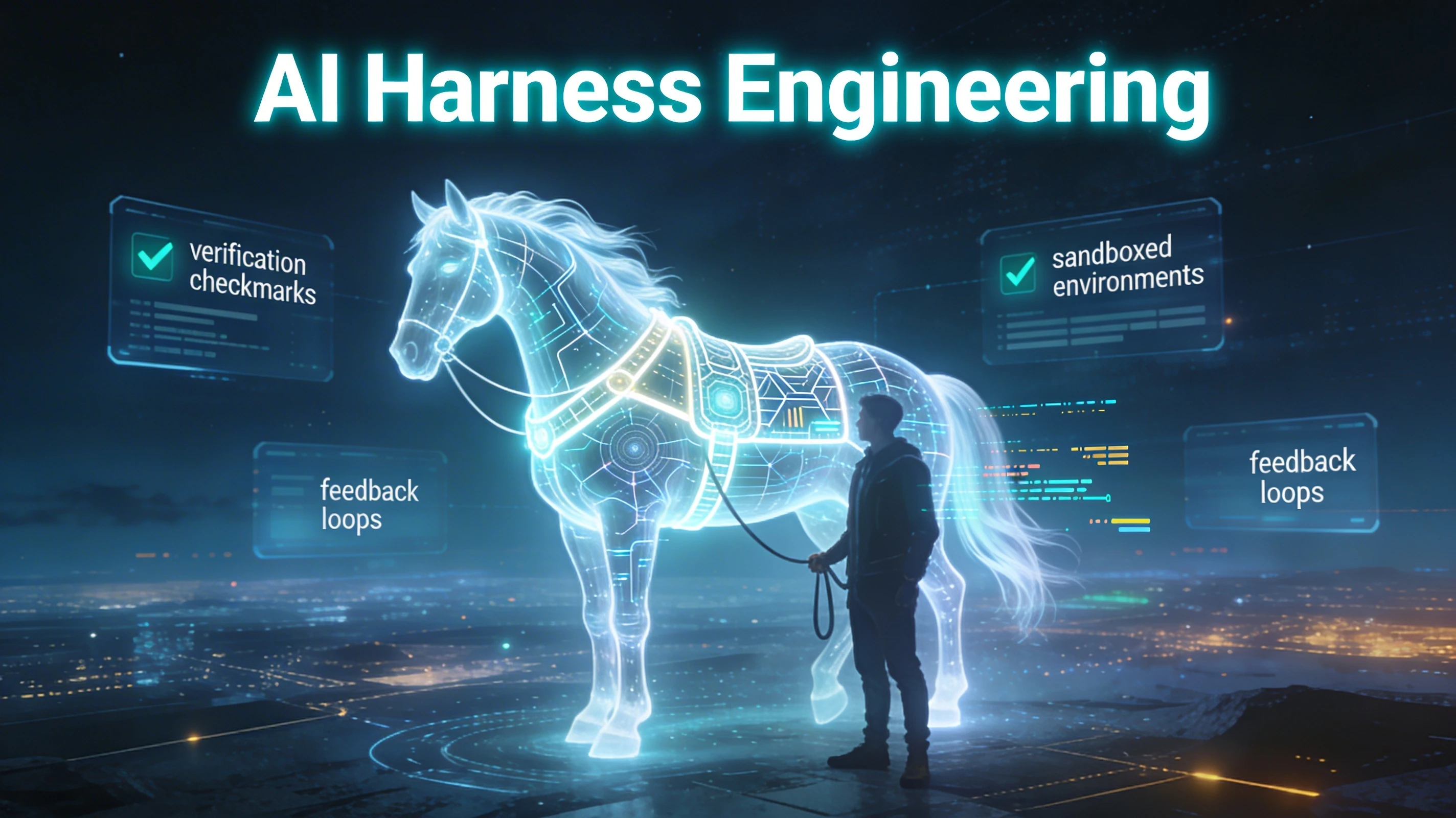
In February 2026, OpenAI published a landmark paper describing how a small team of three engineers used Codex agents to build a production software product — one million lines of code across 1,500 pull requests in five months, without writing a single line of code manually. The secret was not a better model. It was a better harness.
This achievement put a name on a discipline that had been quietly forming across the AI industry: Harness Engineering — the practice of designing the environments, constraints, and feedback loops that make autonomous AI agents reliable at scale.
If 2025 was the year of the AI agent, 2026 is the year we learned to control them.
What Is AI Harness Engineering?
An agent harness is the software infrastructure layer that wraps around an AI model to manage its lifecycle, context, tool access, and safety boundaries. It is not the agent's brain — it is the operating system that governs how the brain operates.
As Martin Fowler's Thoughtworks team frames it: "Harness engineering is the tooling and practices we can use to keep AI agents in check."
The analogy is precise:
| Concept | Traditional Computing | AI Agent World |
|---|---|---|
| The brain | CPU | LLM (GPT, Claude, etc.) |
| The operating system | OS (Linux, Windows) | Agent Harness |
| Resource management | Memory, I/O, processes | Context window, tools, state |
| Security | Permissions, sandboxing | Guardrails, allowlists, HITL gates |
| Orchestration | Kubernetes | Agent control plane |
The harness is to AI agents what Kubernetes is to containers — the control plane that turns raw capability into governed, observable, production-ready systems.
Why Harness Engineering Matters Now
The Agent Sprawl Problem
Enterprises now deploy an average of 12 AI agents, with projections reaching 20 by 2027. Yet only 27% connect to the broader technology stack. The remaining 73% operate as shadow agents — unmonitored, ungoverned, and accumulating technical debt.
This mirrors the microservices sprawl of a decade ago, which led to service meshes and platform engineering. History is repeating itself:
| Era | Problem | Solution |
|---|---|---|
| 2015–2018 | Microservices sprawl | Service mesh (Istio, Envoy) |
| 2018–2022 | Infrastructure sprawl | Platform engineering |
| 2024–2026 | AI agent sprawl | Agent harness engineering |
The Bandwidth Bottleneck
The deeper reason is a fundamental constraint: agent output now exceeds human review capacity. The traditional "write → review → merge" development cycle breaks down when autonomous systems generate more code per hour than senior engineers can evaluate per week.
The scarce resource has shifted from coding speed to human attention. Harness engineering addresses this by automating the validation, constraint enforcement, and quality assurance that humans can no longer perform manually at scale.
The Evolution: Prompts → Context → Harnesses
Harness engineering represents the third major paradigm shift in how we build with AI:
Stage 1: Prompt Engineering (2023–2024) Focused on crafting the right input. Tactical, fragile, and tightly coupled to specific models. Think of it as hand-tuning queries to get good outputs.
Stage 2: Context Engineering (2024–2025) Expanded from single prompts to the entire information environment — RAG pipelines, memory systems, and dynamic context injection. Better, but still reactive.
Stage 3: Harness Engineering (2025–2026) Designs the complete operational environment — not just what the agent knows, but what it can do, how it recovers from failure, and when humans must intervene. The shift is from prompt optimization to environment architecture.
As the Epsilla team puts it: "The engineer's job shifts from producing correct code to producing an environment in which an agent reliably produces correct code."
The Six Core Components of an AI Harness
Drawing from Anthropic, OpenAI, Salesforce, and Martin Fowler's frameworks, a production-grade agent harness consists of six interconnected layers:
1. Context Engineering Layer
The harness curates what the agent knows at each step through:
- Compression — Summarizing session history into essential points to fit within context windows
- Injection — Using RAG to supply relevant data only when needed
- Dynamic prompts — Injecting historical context and real-time state into agent operations
Anthropic's approach uses a claude-progress.txt file that maintains cumulative work logs across sessions, ensuring long-running agents never lose track of completed work.
2. Tool Orchestration Layer
The agent gets a controlled "tool shed" — pre-approved APIs, code execution environments, and external services. The harness:
- Intercepts every tool request
- Validates permissions against allowlists
- Executes commands in isolated, sandboxed environments
- Sanitizes outputs before feeding results back to the model
This is where the harness prevents tool hallucination — when agents invent non-existent functions.
3. Planning and Decomposition Layer
The "thinking corner" where the harness guides the agent to break large goals into structured task sequences. Rather than attempting monolithic tasks, the agent follows decomposed workflows with checkpoints at each step.
OpenAI's Codex harness uses JSON-formatted feature specifications (not Markdown) because models are less likely to inappropriately modify structured data. Each feature includes description, verification steps, and pass/fail status.
4. Verification and Guardrails Layer
Non-negotiable policies enforced at the infrastructure level:
- Cost ceilings — Budget caps per agent per task
- Duration limits — Maximum execution time before escalation
- Blocked output patterns — Regex-based filters for sensitive content
- Tool allowlists — Explicit enumeration of permitted actions
- Structural tests — Architectural constraint enforcement (e.g., dependency flow:
Types → Config → Repo → Service → Runtime → UI)
Martin Fowler's team emphasizes custom linters and pre-commit hooks as mechanical guardrails that no prompt can override.
5. Memory and State Management Layer
Multi-layered persistence across context windows:
- Session memory — Short-term context within a single task
- Progress files — Cumulative logs across multiple sessions (Anthropic pattern)
- Git commits — Immutable history with descriptive messages after each completed feature
- Feature lists — Structured specifications tracking what's done and what remains
Without this layer, agents suffer context drift — gradually losing their original goals amid accumulated information.
6. Human-in-the-Loop (HITL) Controls
The harness identifies high-stakes actions and pauses execution for human review:
- Deleting customer data
- Approving financial transactions above thresholds
- Deploying to production environments
- Modifying security configurations
As Salesforce frames it: "AI provides the labor; humans provide the final judgment."
OpenAI's Codex Case Study: 1 Million Lines in 5 Months
The most concrete proof of harness engineering at scale comes from OpenAI's internal experiment:
| Metric | Value |
|---|---|
| Total code generated | ~1,000,000 lines |
| Pull requests opened and merged | ~1,500 |
| Timeframe | 5 months (Aug 2025 – Jan 2026) |
| Initial team size | 3 engineers |
| Peak team size | 7 engineers |
| Throughput | 3.5 PRs per engineer per day |
| Human-written code | 0 lines |
| Code scope | Application logic, tests, CI config, docs, observability, tooling |
Key Technical Decisions
- Bootable per git worktree — Each Codex task ran in an isolated git worktree, enabling parallel development without conflicts
- Chrome DevTools Protocol integration — Agents could drive the UI directly, take screenshots, capture DOM snapshots, and validate fixes visually
- Documentation as machine-readable artifacts — Structured docs served as the single source of truth, replacing tribal knowledge
- Strict architectural boundaries — Unidirectional dependency flow enforced via structural tests and custom linters
- Declarative prompts — Replacing handcrafted scripts with intent-based specifications
Ryan Lopopolo from OpenAI's technical staff noted: "We built Harness to provide a consistent and reliable way to run large-scale AI workloads."
Anthropic's Long-Running Agent Architecture
Anthropic published a complementary approach focused on multi-session agent continuity:
The Two-Agent Pattern
Initializer Agent (Session 1):
- Creates
init.shfor rapid environment setup - Writes
claude-progress.txtfor cumulative work tracking - Makes an initial git commit documenting the baseline
- Generates a JSON feature list with all specs marked as "failing"
Coding Agent (Sessions 2+):
- Begins each session with diagnostic steps:
pwd, progress file review, git log review - Works on single features, verifying thoroughly before marking complete
- Uses browser automation (Puppeteer MCP) to test like an end user, not just at the code level
- Commits with descriptive messages after each feature
Observed Failure Modes
| Problem | Without Harness | With Harness |
|---|---|---|
| Premature completion | Agent declares "done" with incomplete work | Comprehensive feature list prevents premature exit |
| Undocumented bugs | Bugs accumulate silently | Git repos + progress files create audit trail |
| Context loss across sessions | Agent restarts from scratch | Progress files + git history restore context |
| Environment setup delays | Minutes wasted on each session | init.sh enables instant bootstrapping |
| Invisible failures | Code passes unit tests but fails in real use | Browser-based E2E testing catches UI-level bugs |
The CNCF Four Pillars Applied to Agent Control
The Cloud Native Computing Foundation (CNCF) proposed a framework for autonomous enterprise control that maps directly to agent harness architecture:
1. Golden Paths
Standardized, blessed configurations that teams inherit:
- Approved model/provider combinations
- Default prompt templates and context strategies
- Pre-configured tool sets per use case
2. Guardrails
Non-negotiable policies that cannot be overridden:
- Token budget limits
- Rate limiting on API calls
- Mandatory output filtering
- Prohibited action patterns
3. Safety Nets
Automated recovery mechanisms:
- Exponential backoff on failures
- Fallback to simpler models when primary models fail
- Circuit breakers for runaway agents
- Automatic state snapshots for recovery
4. Manual Review Gates
Human-in-the-loop checkpoints:
- Production deployment approvals
- Data deletion confirmations
- High-value transaction reviews
- Security-sensitive configuration changes
30-60-90 Day Implementation Roadmap
Based on the Epsilla framework, organizations can adopt harness engineering incrementally:
Phase 1: Days 0–30 — Minimum Viable Harness
- Create structured documentation as machine-readable artifacts
- Implement 3–5 custom linting rules for architectural constraints
- Set up basic agent observability (log every tool call, every decision)
- Define tool allowlists for each agent type
Phase 2: Days 31–60 — Close the Observability Loop
- Give agents access to their own logs and metrics (self-monitoring)
- Implement automated acceptance testing replay
- Add cost tracking and budget enforcement per task
- Build session-to-session state recovery
Phase 3: Days 61–90 — Entropy Governance
- Deploy periodic agents that audit for documentation drift
- Implement automated architectural constraint violation detection
- Add technical debt tracking as a first-class metric
- Establish human review workflows for high-stakes actions
Who Needs Harness Engineering?
Harness engineering is not just for AI companies. Any organization deploying autonomous agents in production needs this discipline:
| Role | Why Harness Engineering Matters |
|---|---|
| Engineering Leaders | Governs agent sprawl, enforces architectural standards |
| Platform Teams | Provides golden paths and standardized agent configurations |
| Security Teams | Enforces guardrails, tool restrictions, and audit trails |
| Product Managers | Ensures agents deliver user-value, not just code volume |
| DevOps / SRE | Adds observability, cost control, and failure recovery |
The Future: Harnesses as Service Templates
Martin Fowler's team hypothesizes that harnesses may evolve into standardized service templates, fundamentally reshaping how we design software. Codebases may be optimized not just for human readability but for "harnessability" — how easily AI agents can understand, modify, and maintain them.
The implications are profound:
- Code topology may standardize around patterns that agents navigate best
- Documentation becomes a first-class runtime artifact, not an afterthought
- Testing shifts from coverage metrics to user-value validation
- Architecture decisions are driven by agent controllability, not just human ergonomics
The organizations that master harness engineering will not just deploy more AI agents — they will deploy AI agents that actually work, at scale, safely, and under governance.
In a world where the model is becoming a commodity, the harness is your moat.
References
- Harness Engineering: Leveraging Codex in an Agent-First World — OpenAI
- OpenAI Introduces Harness Engineering: Codex Agents Power Large-Scale Software Development — InfoQ
- Effective Harnesses for Long-Running Agents — Anthropic
- Harness Engineering — Martin Fowler / Thoughtworks
- What Is an Agent Harness? — Salesforce
- Agent Harnesses: Why 2026 Isn't About More Agents — DEV Community
- Harness Engineering: Why the Focus is Shifting from Models to Agent Control Systems — Epsilla
- Harness Engineering: Building the Infrastructure Moat for AI Agents — Dev Journal
- The Rise of AI Harness Engineering — Cobus Greyling
- From Prompts → Context → Harness Engineering — Manjeet Substack
- The Autonomous Enterprise and the Four Pillars of Platform Control — CNCF
- What Is AI Harness Engineering? — Mohit Sewak, Ph.D. / Medium