
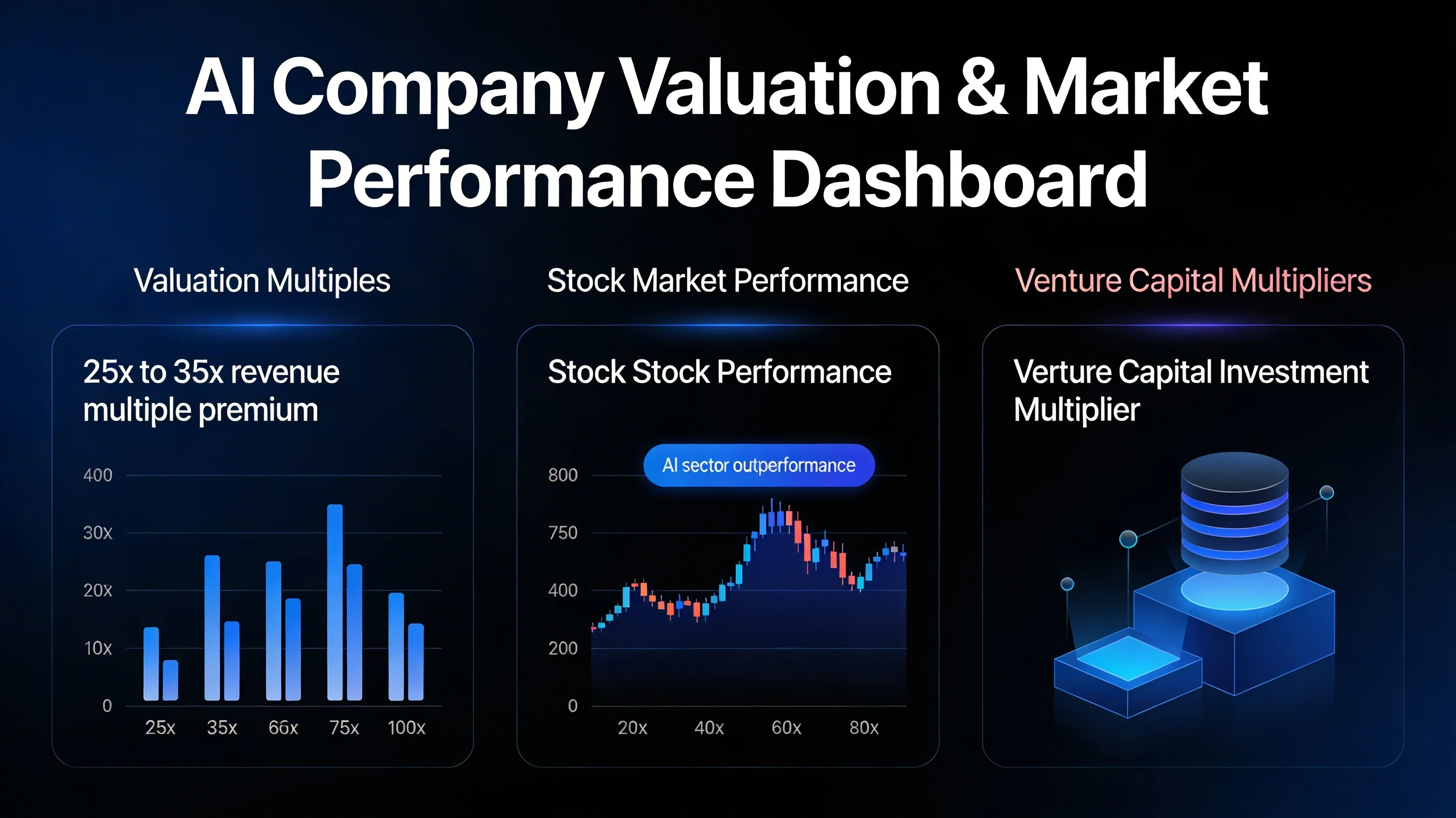
The SaaS valuation playbook that dominated venture and growth equity from roughly 2015 to 2022 centered on a well-understood framework: annual recurring revenue, net revenue retention, gross margin, and CAC payback period. Companies with strong scores on these metrics earned multiples of 15x to 20x ARR at peak. Companies with exceptional scores occasionally commanded 30x.
AI companies in 2024 and 2025 are receiving 25x to 35x multiples while many of the traditional SaaS metrics look worse: lower net revenue retention than the best SaaS businesses, margins compressed by inference costs, customer churn patterns that don't fit neatly into the SaaS model, and revenue profiles that are half usage-based and half subscription in ways that confuse standard forecasting.
The premium is not irrational, but the reasons for it require careful unpacking.
What Investors Are Actually Pricing In
When a growth equity fund prices an AI application company at 30x forward revenue, they are not primarily valuing the cash flows from the existing business. They are pricing a combination of:
Capability trajectory: Foundation model capabilities are improving fast enough that the gap between what an AI product can do today and what it will be able to do in twenty-four months is genuinely uncertain — and in many categories, the trajectory suggests substantially improved capability at lower cost. An investor pricing a company today is pricing expected future capability, not just current capability.
Market expansion: Many AI applications are creating market categories that did not exist before rather than competing for share in an established market. Code generation tools are not a replacement for some other software developer productivity tool — they are creating a new category of leverage that developers will pay for in addition to, not instead of, their existing tooling. The total addressable market is expanding, which changes the denominator in the multiple calculation.
Switching cost accumulation: AI products that integrate deeply into workflows accumulate switching costs over time as users become dependent on the product's specific behavior, integrations, and outputs. An AI coding assistant that has learned your codebase's patterns, your team's conventions, and your organization's specific technology stack is harder to replace than a generic productivity tool. Investors pay premiums for sticky products.
Winner-take-most dynamics: Several AI application categories appear to have winner-take-most characteristics where the player with the most users generates the most training data, which produces the best product, which attracts the most users. Network effects of this type justify premium multiples because the terminal value for the category winner is dramatically higher than for the second-place player.
The Metrics That Actually Matter
Traditional SaaS metrics do not map cleanly onto AI companies, but several modified metrics have emerged as the right lenses:
| Metric | Traditional SaaS Benchmark | AI Company Reality | What to Watch Instead |
|---|---|---|---|
| Net Revenue Retention | 120%+ gold standard | Lower gross retention, high expansion in sticky customers | 18-24 month cohort analysis |
| Gross Margin | 70-80% | 50-60% (compressed by inference costs) | Inference cost trajectory (90% decline over 2 years) |
| Revenue Model | Subscription (predictable) | Hybrid usage + subscription | Cohort spending growth over time |
Gross Retention vs. Net Retention
In traditional SaaS, net revenue retention above 120% — meaning existing customers expand their spending enough to more than offset churn — is the gold standard metric. AI companies with usage-based pricing often show a different pattern: low gross revenue retention (customers churn at higher rates than SaaS benchmarks because they are experimenting more broadly) but high expansion in the customers that stick.
For AI companies with this profile, the right metric is cohort analysis over 18-24 month windows rather than trailing 12-month NRR. A company where customers who are still present after 18 months are spending 3x their initial contract value is a strong business even if early-stage churn is elevated.
Inference Margin vs. Gross Margin
SaaS gross margins of 70-80% are the standard against which AI companies are sometimes unfavorably compared, as inference costs compress margins. But the relevant comparison is not today's inference margin — it is the trajectory of inference cost.
Inference costs for equivalent capability have fallen by roughly 90% over the past two years. A company with 55% gross margins today that is on a path to 72% gross margins when the next generation of more efficient models is deployed is very different from a company stuck at 55%. Investors who understand the cost trajectory price the future margin, not the current one.
Velocity of Customer Success
For AI products that automate or augment knowledge work, the most meaningful leading indicator of long-term retention is whether customers can point to specific, measurable outcomes. Teams that generate concrete ROI stories — "we cut our PR review cycle from 4 hours to 40 minutes" or "our agent triaged 600 support tickets last week that would have taken 3 full-time agents" — are dramatically better positioned for renewal and expansion than teams where the value is vaguely articulated.
Investors evaluating AI companies are increasingly asking not just about ARR and churn, but about the quality of customer success stories. An anecdotal but compelling ROI story often predicts retention better than aggregate metrics, because it indicates that at least some customers have achieved genuine integration into their workflows.
Where Premium Multiples Are Justified vs. Fragile
Not all 30x multiples are created equal. Some are supported by structural advantages that will persist; others reflect momentum and narrative more than durable fundamentals.
Multiples that are structurally supported:
- Companies with proprietary training data that competitors cannot easily replicate — especially data generated from their own product usage
- Companies with deep workflow integration that creates genuine switching costs, not just superficial stickiness
- Vertical specialists with domain-specific capabilities that general-purpose models cannot replicate without specialized fine-tuning
- Infrastructure and tooling companies that become more valuable as the total number of AI applications grows (a rising-tide dynamic)
Multiples that are fragile:
- Companies whose core capability is an API wrapper around foundation models without meaningful product differentiation — these face compression as foundation model capabilities improve and base costs fall
- Companies valued primarily on user count rather than revenue, where the path from user to paying customer is unclear
- Companies in categories where two or three better-funded competitors are within 12 months of shipping comparable capability
- Companies with high gross churn masked by aggressive expansion in the customers that stay — eventual gross churn normalization can dramatically change the unit economics story
The Infrastructure Layer Premium
One underappreciated dynamic in AI company valuations is the premium commanded by companies that sit in the infrastructure layer rather than the application layer.
Application companies are subject to the risk that a foundation model provider builds their feature natively into the base model or API. This risk is real and has materialized for several categories — code completion, basic summarization, and translation, among others. As foundation models become more capable, more application-layer value gets absorbed upward.
Infrastructure companies — those providing observability, deployment, evaluation, fine-tuning, and governance for AI applications — face a different risk profile. Their value increases with the number of AI applications deployed, which is a tailwind rather than a threat. The analogy is to database tooling companies during the SaaS era: as more SaaS companies were built, the demand for database monitoring and performance tooling grew proportionally.
This infrastructure premium is one reason that companies like Langfuse (LLM observability), Helicone, and similar tooling vendors commanded multiples that surprised people who expected them to be simple SaaS businesses.
Applying the Framework
For anyone building in or investing in the AI space, these valuation dynamics create practical guidance:
If you are building an AI product, the most valuable thing you can do for your company's long-term multiple is identify and develop a genuine moat. Proprietary data, deep workflow integration, switching costs from accumulated learning — these are the things that separate premium-multiple businesses from the commodity layer.
If you are evaluating AI investments, the most important question is not what the current revenue multiple is, but whether the structural advantages that justify the multiple are real and defensible. Premium multiples are only rational when they reflect genuine long-term competitive advantages, not just momentum.
And if you are building developer tooling in the AI space, the infrastructure premium is a real phenomenon worth orienting your product around.