
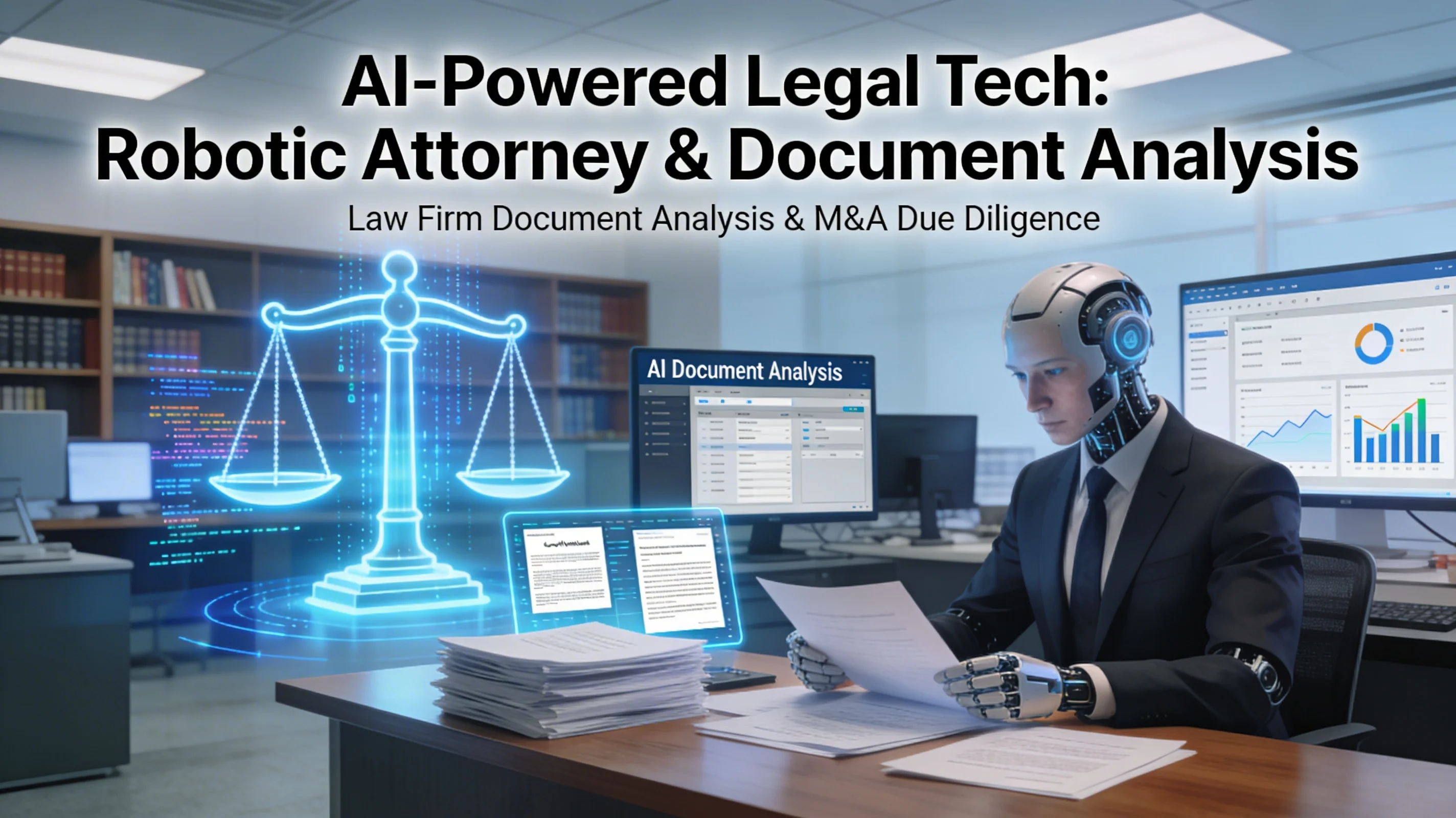
The legal industry's relationship with AI automation has followed an unusual pattern relative to other professional services sectors. It was among the first industries to deploy document processing AI at scale—contract review and due diligence automation tools have existed in commercial form since 2015—but it has been slower than finance or healthcare to adopt agentic systems that can reason across documents and take autonomous action.
The reasons are structural. Legal work carries a particularly high cost of error. A misclassified financial transaction can be corrected; advice that leads a client into an adverse legal position creates liability that is more difficult to unwind. The professional responsibility framework that governs attorney conduct creates genuine uncertainty about how responsibility is allocated when AI contributes to legal work product. And the billable-hour model that dominates legal services pricing has historically created economic disincentives for efficiency-improving technology at firms whose revenue scales with the hours expended.
These structural constraints are real, but they are eroding. The economic pressure from clients demanding fixed-fee arrangements, the competitive pressure from legal process outsourcers who have invested heavily in automation, and the capability improvements in foundation models that have made AI legal analysis genuinely reliable across a broader range of tasks are collectively driving adoption at a pace that the industry's structural caution has not fully arrested.
Contract Review: The Mature Use Case
The most established AI agent application in legal is contract review and abstraction. The task is well-suited to current AI capabilities: large volumes of documents, defined clause taxonomy, clear accuracy benchmarks (against experienced human reviewer performance), and relatively low-stakes errors (at the individual clause level) that can be caught in human review.
Enterprise legal departments processing significant contract volumes—corporate procurement, real estate, financial services—have achieved meaningful efficiency gains through AI contract review. The typical deployment extracts defined clause types (limitation of liability, indemnification, intellectual property ownership, termination rights, governing law), flags non-standard language against playbook benchmarks, and risk-scores contracts before human review.
The accuracy figures for current generation contract review AI on well-defined clause types are consistently above 92% against expert reviewer benchmarks—high enough that firms are comfortable using AI extraction as a first pass that humans review for exceptions rather than as a suggestion that humans verify comprehensively. This is the same trust calibration dynamic that appears in every mature AI automation deployment: you start with high review coverage and expand autonomy as the empirical error rate justifies it.
What is newer is the shift from passive extraction to active reasoning. Earlier contract AI could identify that an indemnification clause was present and flag that its scope was broader than the playbook standard. Current agentic systems can analyze how that non-standard indemnification clause interacts with the limitation of liability clause in the same contract, compare both to the counterparty's standard form provisions from prior transactions, and generate a negotiation recommendation—all as part of a single automated workflow.
M&A Due Diligence: The High-Stakes Frontier
The highest-profile current application of AI agents in legal is M&A due diligence. A typical acquisition of a mid-size private company involves reviewing several hundred to several thousand documents across legal entity structure, material contracts, intellectual property ownership, employment agreements, regulatory compliance, and litigation history. This work is time-sensitive, high-stakes, and involves identifying issues of varying importance buried across a large document set.
The agent workflow for due diligence has three distinct phases that map to current AI capabilities differently.
| Due Diligence Phase | Automation Level | Time Impact | AI Reliability |
|---|---|---|---|
| Document ingestion and triage | Highly automatable | 3-5 days reduced to hours | High |
| Issue identification within documents | Partially automated | Significant progress, residual uncertainty | High for standard issues, lower for non-standard |
| Issue synthesis and materiality assessment | Human-led | Agent provides supporting data | Low for contextual judgment |
Document ingestion and triage is highly automatable. Classifying documents by type, extracting document metadata, and identifying the highest-priority items for human review based on document type and flagged terms can be handled with high reliability. This phase is where the time savings are most dramatic: the work of sorting through a data room and creating an organized review queue that previously took associates three to five days of focused effort can be completed in hours.
Issue identification within documents is the phase with the most significant recent progress and the most residual uncertainty. AI agents are now reliable at identifying standard legal issues (change of control provisions that would be triggered by the transaction, intellectual property assignments that are incomplete, non-compete provisions that affect the business being acquired) in a review posture. The reliability degrades for non-standard issues—risks that require judgment about what is unusual or material in the specific transaction context—and for issues that require reasoning across multiple documents rather than identification within a single document.
Issue synthesis and materiality assessment remains substantially human-led. The process of taking a list of identified issues, understanding which ones matter for the specific transaction at the specific deal price, and formulating recommendations for the deal team requires contextual judgment about the transaction strategy, the acquirer's risk tolerance, and the legal landscape in the relevant jurisdictions that current agents do not reliably provide.
The current best practice is deploying agents aggressively in phases one and two, which generates time savings that allow deal teams to allocate more human attention to phase three—the synthesis work that creates the most value. Law firms reporting the highest client satisfaction in AI-augmented due diligence are not the ones running the most autonomous processes; they are the ones who have used automation to free senior attorney time for the judgment-intensive work where senior attorney time creates the most value.
Legal Research: Transformation in Progress
Legal research is a domain where AI capability improvements have been particularly rapid and where the implications for legal practice structure are most significant. The traditional legal research workflow—keyword search across case databases, manual review of potentially relevant cases, synthesis of holdings and reasoning into a coherent analysis—is time-consuming, expensive, and heavily reliant on junior attorney time for the initial identification work.
AI agents for legal research can now produce credible first-draft research memos on well-defined questions of law, complete with case citations, analysis of circuit splits or jurisdictional variations, and identification of potentially distinguishable authority. The quality of this output varies significantly with the specificity of the research question and the jurisdiction—better in US federal courts with dense case law, weaker in specialized regulatory areas or foreign jurisdictions with limited English-language training data.
The limitation that received the most public attention—AI hallucination of case citations—has been substantially addressed in purpose-built legal research tools that operate against verified databases of legal authority. The more subtle remaining limitation is the inability to perform the kind of strategic research framing that experienced legal researchers do: understanding what a court is likely to be persuaded by, not just what the formal authority says, requires pattern recognition across judicial behavior that is difficult to capture in training data.
Professional Responsibility and AI
The American Bar Association's 2024 guidance on AI use in legal practice, followed by state bar opinions in most major jurisdictions, has established that attorneys retain full professional responsibility for AI-assisted work product. The principle of competence requires attorneys to understand the tools they are using well enough to evaluate the quality of their output. Supervision requirements that apply to non-attorney staff extend to AI systems performing substantive legal work.
These are not hypothetical constraints. They are the framework within which AI agent deployment in legal practice must be designed. The implication is that every agentic legal workflow requires explicit human review at the points where professional judgment is being exercised—and those review points need to be designed into the workflow, not bolted on after the fact.
This creates a design principle for legal AI deployment that is similar to the broader principle in high-stakes agent deployments across industries: the human review requirements do not diminish the value of automation in the stages preceding them. Agents that handle the first 80% of the work—document ingestion, initial analysis, issue identification, draft synthesis—create enormous value even when a human is required to validate and finalize. The constraint is not an obstacle to deployment; it is the design requirement that shapes what good deployment looks like.
The Path to More Autonomous Operation
The legal industry will move toward greater agent autonomy in specific, bounded domains before general autonomous operation becomes appropriate. The domains where this is most likely to occur first are those with high volume, well-defined outcomes, and established feedback loops that make it possible to measure error rates and improve over time.
Contract playbook enforcement in standard commercial agreements, routine regulatory filings with defined templates, trademark watch monitoring and initial infringement screening, and document collection and organization in discovery workflows are all candidates for substantially autonomous operation within a relatively near time horizon.
The expansion of autonomy will follow the pattern established in every other professional domain where AI agents are deployed in high-stakes contexts: demonstrated reliability in a bounded task class, extended to adjacent tasks as confidence is established, always with human oversight retained at the decision points where error consequences are highest.
The legal industry's structural caution about AI is not irrational. But it is also not static. The trajectory is clear, and the firms and departments building the infrastructure to support agentic workflows now will have the implementation experience and the calibrated trust in specific agent behaviors that will allow them to expand autonomy responsibly as capability continues to develop.