
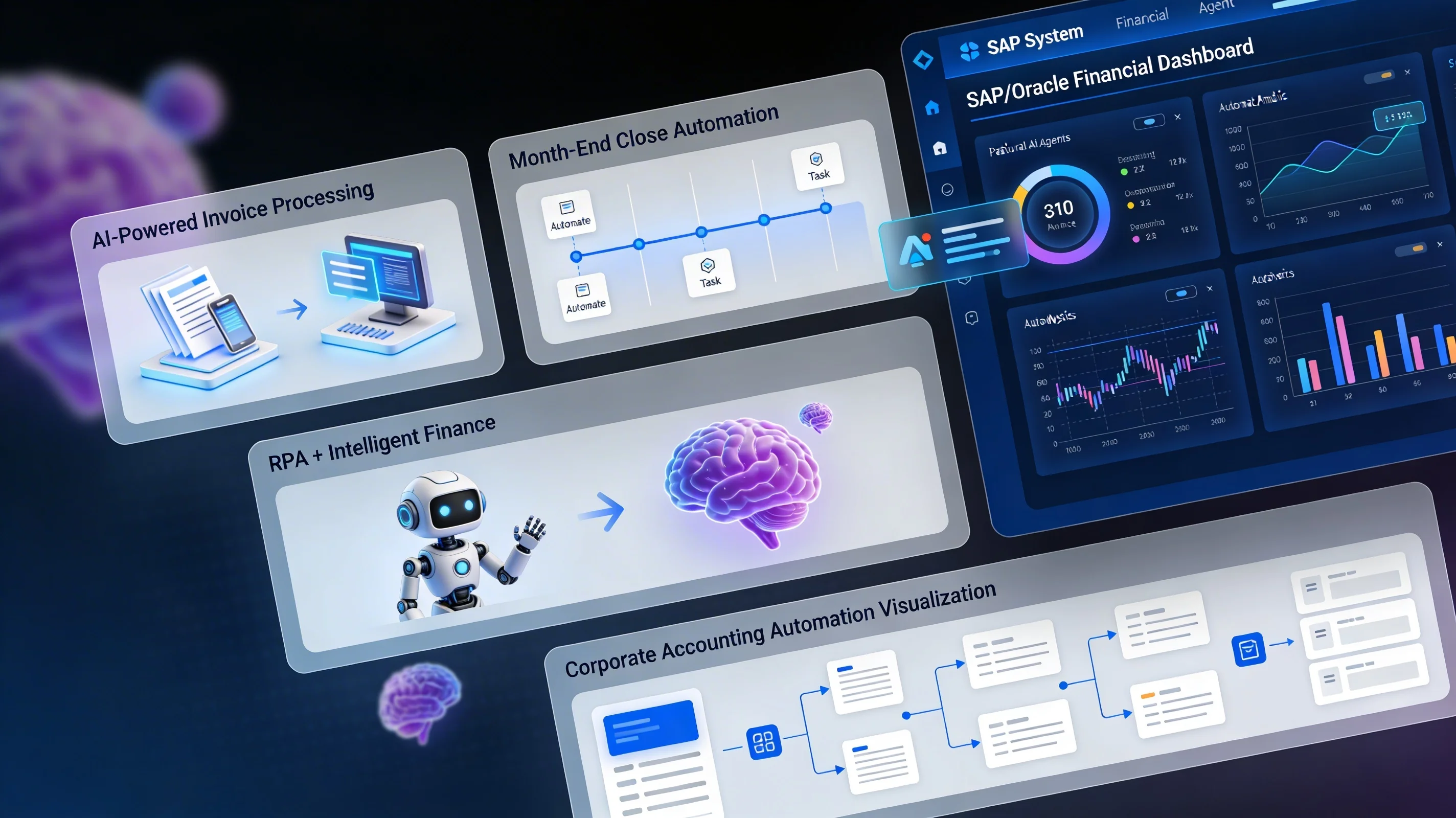
The phrase "touchless operations" has been a recurring feature of enterprise software marketing for fifteen years. Workflow automation tools, robotic process automation platforms, and intelligent document processing systems have each arrived promising to eliminate manual intervention from finance processes—and each has partially delivered, while leaving a residual layer of exception handling, reconciliation work, and judgment calls that required human attention.
The arrival of native AI agents embedded directly in ERP platforms represents a qualitatively different capability. Not because the underlying AI is categorically more powerful than earlier approaches, but because integration depth changes the class of problems that can be automated. An agent that natively reads the general ledger, understands the account hierarchy, has access to historical transaction patterns, and can execute journal entries without exiting the platform is capable of handling a fundamentally broader range of financial workflows than any external automation layer.
What "Native" Means and Why It Matters
The distinction between native ERP agents and external automation deserves precise treatment because vendor marketing tends to blur it.
External automation—RPA bots, integration middleware, API-connected AI tools—interacts with ERP systems through the same interfaces available to humans or third-party integrations. They can read and write data, trigger workflows, and capture outputs. Their limitation is that they operate at the boundary of the system, working with the data that is explicitly exposed, in the formats that interfaces provide.
Native agents are implemented within the ERP platform's own architecture and have access to the platform's internal services, not just its external interfaces. A native agent in SAP S/4HANA has access to the same transaction context, posting logic, and validation rules that the platform's own processes use. It does not need to reverse-engineer what an account balance means from the API response—it has direct access to the internal representation. For financial workflows, where the semantics of transactions depend heavily on context that is often implicit in the platform's data model, this distinction produces meaningfully different capabilities.
SAP's Joule, Oracle's AI agents in Fusion Cloud Financials, and Microsoft Copilot for Dynamics 365 Finance each represent different architectural approaches to native integration, but they share the characteristic that the agent's access to financial data and transaction execution capability is deep rather than surface-level.
The Touchless Month-End Close
The month-end close is the most demanding regular cycle in corporate finance. For a mid-size company, the close process typically involves 80 to 200 discrete tasks across accounts payable reconciliation, accounts receivable aging review, intercompany eliminations, accrual entries, variance analysis, and financial statement preparation. For most organizations, this process takes five to ten business days and consumes significant finance team capacity.
The touchless close is not a single agent but a coordinated pipeline of agents, each handling a category of tasks for which automated execution is reliable and safe. The current state of the art, based on deployments at early-adopter organizations, looks roughly as follows:
Fully automated (no human touch required):
- Routine journal entries with definitive matching criteria
- Bank reconciliation for accounts with electronic transaction feeds
- Fixed asset depreciation calculation and posting
- Intercompany transaction matching where both sides are in the same ERP instance
- Standard accrual entries based on contract schedules
- Variance flagging against budgets and prior-period actuals
Agent-assisted (agent prepares, human reviews and approves):
- Complex intercompany eliminations involving multiple currencies and legal entities
- Significant variance analysis with narrative generation
- Unusual transaction investigation and classification
- Judgment-based accruals for items requiring estimation
- External reporting preparation
Human-led (agent provides supporting information):
- Revenue recognition judgments under ASC 606 / IFRS 15
- Impairment assessments
- Disclosure preparation for complex transactions
- Auditor-facing explanations and workpaper preparation
Organizations that have completed full implementation of this pipeline report close cycle compression from an average of seven business days to three. The reduction in elapsed time is partly from automation of routine tasks and partly from agents running parallel workflows that humans execute sequentially.
Invoice Processing: Where ROI Is Most Visible
Accounts payable automation is the most mature application of AI agents in ERP systems and the category with the most verifiable ROI data. The baseline metrics from manual invoice processing—cost per invoice typically ranging from $12 to $30 for organizations without automation, processing times of five to fifteen days, error rates of 1-3%—provide a clear benchmark against which agent performance can be measured.
Native AI agents handling accounts payable achieve cost per invoice in the $1.50-$4 range for straight-through processing (invoices that match purchase orders and can be approved automatically), with processing times measured in minutes rather than days. The key innovation over prior-generation OCR and workflow automation is the ability to handle non-standard invoice formats, infer line-item matching from semantic content rather than just field positions, and resolve common exceptions (duplicate invoices, minor quantity discrepancies within tolerance thresholds, new vendor formats) autonomously rather than routing every exception to a human queue.
| Metric | Manual Processing | AI Agent Processing |
|---|---|---|
| Cost per invoice | $12-$30 | $1.50-$4 (straight-through) |
| Processing time | 5-15 days | Minutes |
| Error rate | 1-3% | Lower (with autonomous exception handling) |
| Annual cost (50K invoices) | ~$900K (at $18 avg) | ~$150K (at $3 avg) |
For a company processing 50,000 invoices annually, the cost reduction from $18 per invoice to $3 per invoice—a conservative estimate for a hybrid human/agent operation—represents $750,000 in annual direct cost savings. The faster payment cycle creates additional value through early payment discount capture: many vendor contracts offer 1-2% discounts for payment within 10 days that organizations with slow manual processes systematically miss.
The Treasury and Cash Management Agent
The most sophisticated native agent deployments in financial operations are moving into treasury management—an area that combines real-time data requirements with high-stakes decision execution. Treasury agents are responsible for monitoring cash positions across multiple bank accounts and legal entities, forecasting short-term liquidity needs, executing inter-entity transfers to optimize cash utilization, and managing short-term investment of excess liquidity within defined policy parameters.
The critical design constraint in treasury agent deployments is the policy boundary: a well-designed treasury agent will not execute transactions that fall outside explicitly defined parameters, will escalate to human treasury managers for any action above defined threshold amounts, and will maintain complete audit trails of every action taken and every decision deferred. The value of the agent is not in replacing treasury judgment—it is in ensuring that treasury policy is executed consistently and immediately across all entities rather than being applied opportunistically when a human happens to check the cash position.
What This Means for Finance Teams
The finance professionals who will thrive in an ERP-native agent environment are those who can do what agents cannot: exercise judgment about unusual situations, build relationships with business partners, communicate financial context to non-finance decision-makers, and redesign processes when the patterns that agents are optimized for break down.
The finance roles that will experience the most structural change are those concentrated on high-volume, rule-based processing: staff accountants handling routine journal entries, AP clerks processing standard invoices, AR analysts running standard aging reports. These are not entry-level roles in the pejorative sense—they are roles that required real skill when the volume of work required human execution, and they are the roles where agent capabilities are most directly substituting for human time.
The career development implication is clear: finance professionals who have developed deep analytical judgment, business partnership skills, and the ability to evaluate AI-generated financial outputs are building capabilities that compound in value as agent automation takes over the transactional layer. Those who have not will face increasing pressure as the supply of routine processing tasks that justify their roles diminishes.
Integration with Non-ERP Agent Platforms
One friction point in native ERP agent deployments is the boundary they create between financial workflows and the broader operational systems that feed them. A native SAP agent is optimized for SAP environments; it does not naturally extend to the CRM data, the supply chain system, or the project management tools that provide upstream context for financial transactions.
This is where platforms like Neumar, with broad MCP integration across enterprise tools, provide complementary value. An agentic financial workflow that begins with a customer order in Salesforce, flows through project management, and terminates in ERP posting cannot be handled end-to-end by any single system's native agent. The coordination layer that connects these systems and routes work appropriately between specialized agents is the integration infrastructure that the next generation of enterprise automation requires.
The future of financial operations is not a single agent handling everything. It is an ecosystem of specialized agents—each deep in its domain—coordinated by orchestration infrastructure that can route work, pass context, and maintain consistency across system boundaries.