
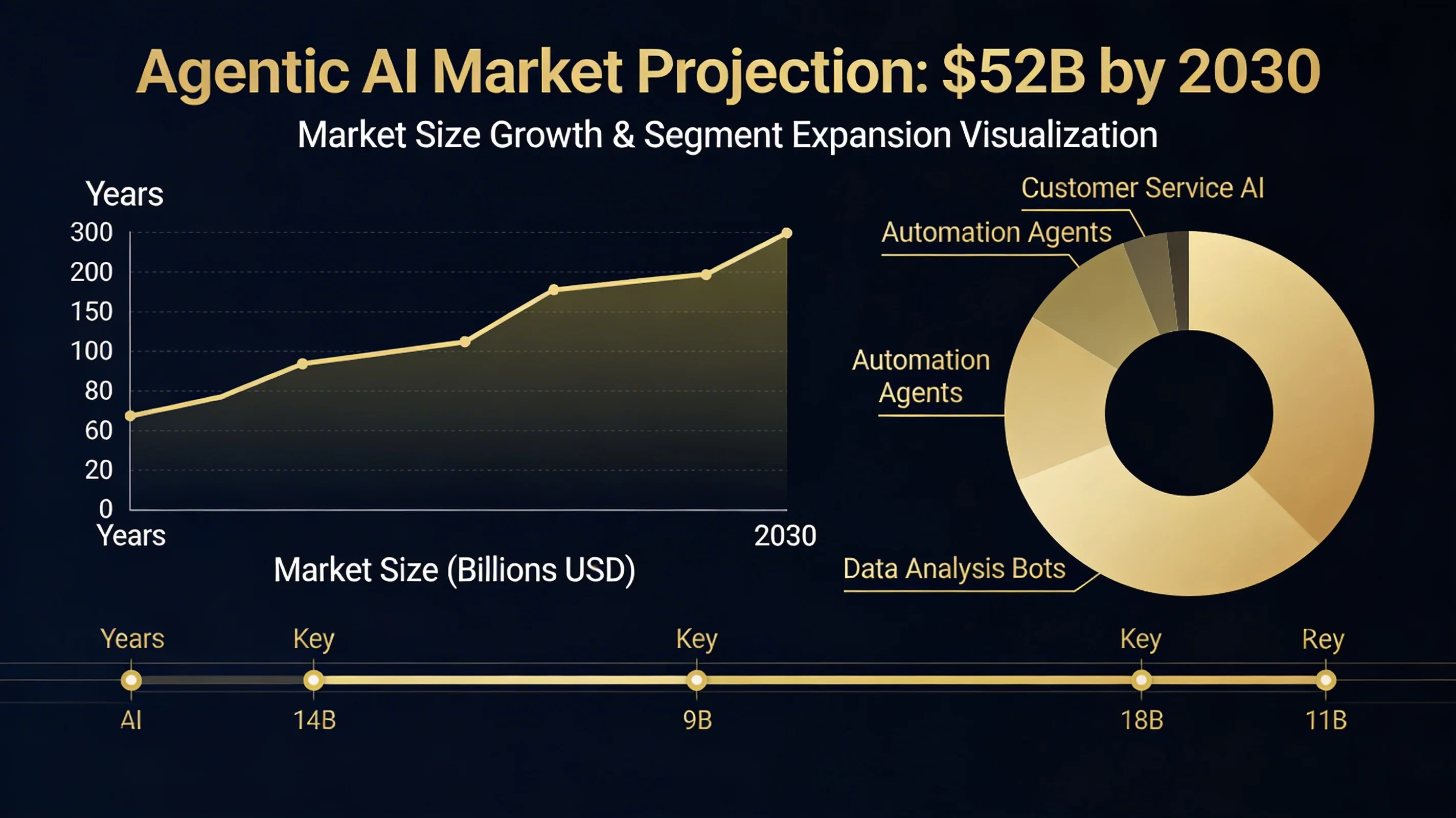
Market sizing projections for agentic AI range from $28 billion to $120 billion by the early 2030s, depending on which analyst firm, which methodology, and which definition of "agentic AI" you use. The $52 billion figure that has circulated most widely in 2025 comes from a Grand View Research report that combines enterprise software displacement, new automation market creation, and infrastructure spending into a total addressable market estimate with a CAGR somewhere around 40%.
There is genuine signal in these projections — the structural tailwinds are real. There is also considerable noise. Separating them requires looking at the underlying assumptions rather than the headline number.
The Methodology Problem with AI Market Sizing
Before evaluating the $52 billion projection, it is worth understanding how AI market sizing reports are typically constructed, because the methodology shapes how much weight you should give the number.
Most analyst market sizing reports for AI categories use some combination of:
| Methodology | Approach | Key Limitation |
|---|---|---|
| Top-down estimation | Start with total addressable labor cost, apply adoption/penetration rates, adjust for software capture | Sensitive to labor displacement assumptions |
| Bottom-up comparables | Extrapolate from current revenue of companies in the category | Only as good as current market coverage |
| Survey-based projections | Survey enterprise buyers about intended AI spending, aggregate and extrapolate | Systematically overestimates (respondents over-report) |
Top-down estimation: Start with the total addressable labor cost in categories that AI could automate. Apply an adoption rate. Apply a penetration rate. Adjust for software capture rates (what fraction of displaced labor cost becomes software spend). The result is a market size estimate.
Bottom-up comparables: Look at the current revenue of companies operating in the category. Extrapolate growth rates. Sum to a total.
Survey-based forward projections: Survey enterprise technology buyers about their intended AI spending. Aggregate and extrapolate.
Each approach has significant limitations. Top-down estimates are sensitive to assumptions about labor displacement that range from plausible to wildly optimistic. Bottom-up comparables are only as good as the current market coverage. Survey-based projections systematically overestimate technology adoption because survey respondents over-report intended spending.
The $52 billion figure is plausibly constructed from a top-down analysis of enterprise software automation markets with reasonable-looking but optimistic assumptions. If the assumptions are conservative, the number is an underestimate. If AI capability progress stalls, the number is a significant overestimate.
The Structural Tailwinds That Are Well-Founded
Despite the methodological caveats, several structural forces support meaningful growth in the agentic AI market, independent of the specific number:
The Knowledge Work Automation Wave
The first wave of software automation targeted structured, rules-based tasks: data entry, form processing, document routing. RPA (Robotic Process Automation) is the most prominent example. This wave generated roughly $25 billion in annual software spending and automated a fraction of knowledge work tasks.
The second wave — AI agents — targets the unstructured, judgment-intensive tasks that RPA could not touch. Writing code, drafting documents, analyzing data, managing communications, coordinating multi-step processes. The value of this work is dramatically larger than the RPA-addressable market, and AI agents are now capable enough to handle meaningful portions of it.
The total addressable labor cost in knowledge work is measured in trillions of dollars annually. Even a small percentage of that being captured as software spend represents a large market. The question is not whether the market is large — it is — but how quickly and completely the capture happens.
Developer Productivity as the Leading Edge
The clearest evidence that agentic AI generates genuine value is in developer productivity. Code generation, automated testing, PR review, documentation generation, and bug detection are all categories where multiple independent studies have measured meaningful productivity improvements — not survey-reported perceptions of productivity, but output metrics like pull requests merged per week, bugs found before production, and documentation coverage.
This category matters for market sizing because developers are early adopters who move faster than the broader enterprise population and whose adoption patterns tend to predict broader enterprise technology trends. The developer productivity agentic AI market is currently a few billion dollars annually and growing rapidly. It is also the category where companies can measure ROI most precisely, which tends to accelerate adoption.
The Infrastructure Multiplier
A portion of the agentic AI market that is often undercounted in projections is the infrastructure layer: the tooling, platforms, observability, and managed services required to deploy and operate agents in production.
This layer has historically represented 15-25% of total technology category spend in enterprise software markets. For agentic AI, the infrastructure requirements are more complex than for conventional software — memory management, tool execution environments, security sandboxing, audit logging, and model management all require specialized tooling. The infrastructure share may be higher than in previous categories.
Neumar's stack illustrates the infrastructure requirements concretely. Running agents that reliably execute multi-step workflows requires: a persistent memory system, an MCP-based tool execution layer, a streaming protocol for real-time visibility into agent progress (the AG-UI protocol), observability integration (Langfuse for LLM tracing), and a security model that controls what each agent can access. None of these are trivial. The aggregate spend on this infrastructure layer across the enterprise is substantial.
Where the Projections Require Skepticism
The Reliability Gap
The central bottleneck on agentic AI market growth is not capability — foundation models can already do impressive things. It is reliability. Enterprise adoption of autonomous agents scales in proportion to the probability that the agent does the right thing on any given task execution.
The current state is that AI agents are reliably useful on well-scoped tasks with clear success criteria and low error costs. They are unreliable on ambiguous tasks, tasks requiring complex judgment, and tasks where errors have significant downstream consequences. Expanding the market from the first category to the second requires reliability improvements that are happening but are not guaranteed to arrive on the timeline that $52 billion by 2030 implies.
If reliability improvements come faster than expected (plausible given the current pace of model development), the market could exceed projections. If they plateau — if current models are near the reliability ceiling for a meaningful category of tasks — the market will grow more slowly.
Adoption Friction in the Enterprise
Enterprise technology adoption is slower than vendor projections consistently predict. Security reviews, integration complexity, organizational change management, and budget cycles all add latency between when a technology is technically ready and when it is widely deployed.
The enterprises that move fastest on agentic AI deployment are typically technology companies and startups — organizations with strong engineering capabilities, high risk tolerance, and fast decision cycles. The broader enterprise population — manufacturing, government, healthcare systems, financial services in regulated contexts — moves much more slowly.
The $52 billion projection implicitly assumes that agentic AI adoption reaches a substantial portion of the enterprise population by 2030. That is possible but requires adoption patterns that are faster than most comparable technology waves.
The Open-Source Variable
The commercial market projections do not adequately account for the open-source ecosystem. A significant portion of what commercial agentic AI products provide will be built on open-source foundations: open-source models, open-source orchestration frameworks (LangGraph, etc.), open-source tool integration standards (MCP), and open-source infrastructure components.
As these foundations improve, the cost of building capable agents decreases and the share of enterprise agentic AI that is built in-house rather than purchased from vendors may grow. This compresses the commercial market even as the total value generated grows.
A More Useful Frame Than Market Size
For practitioners building or deploying agentic AI, the market size number is less useful than the underlying questions it forces:
Which task categories are crossing the reliability threshold now? The categories where agents are reliable enough for production deployment today — code assistance, data analysis, document processing — are where revenue is being generated. Mapping those carefully is more useful than guessing at a 2030 total.
What infrastructure investments compound over time? The organizations building strong foundations today — memory systems, tool registries, security frameworks, observability infrastructure — will deploy future capability improvements faster than those starting from scratch. The infrastructure investment pays off across multiple product generations.
Where does your specific use case sit in the adoption curve? Enterprise AI agent adoption is not uniform. Developer tools are 18-24 months ahead of HR automation, which is 12-18 months ahead of regulated-industry process automation. Understanding where your use case sits helps calibrate realistic timelines.
The $52 billion projection probably understates the long-term opportunity if AI capability continues on its current trajectory. It probably overstates the speed of near-term adoption for the broader enterprise market. The nuanced version — faster than most enterprise technology waves, slower than the most optimistic projections, with enormous variance across use cases and industries — is less satisfying as a headline but more useful as a planning assumption.